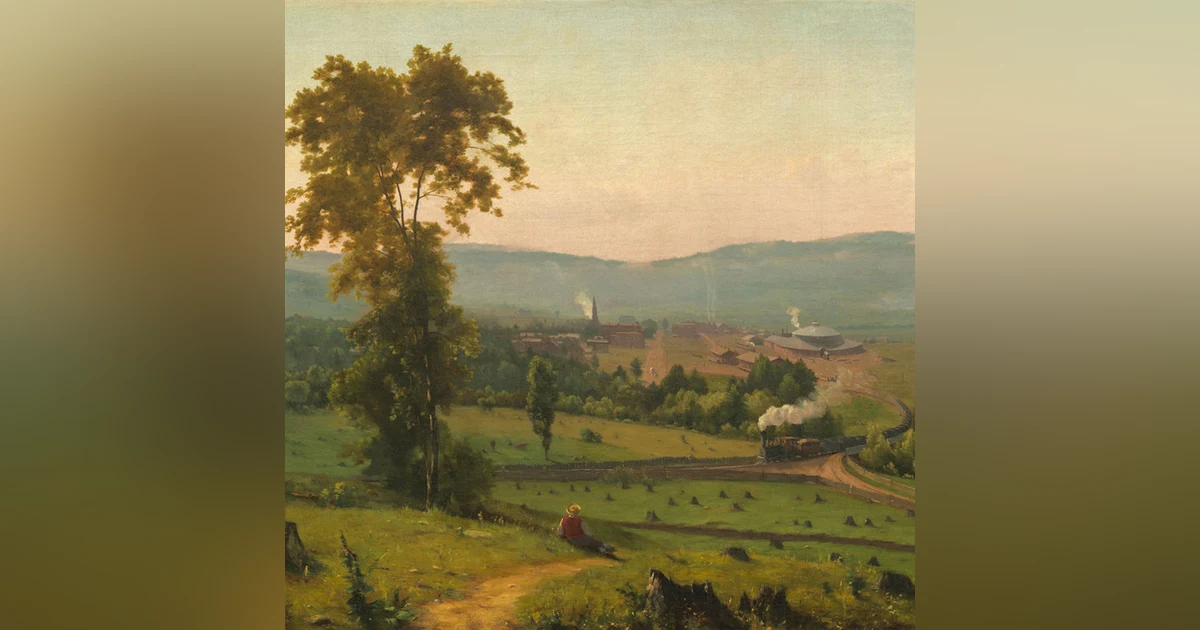
The Lackawanna Valley by George Inness


 Podcast Addict
 Overcast
George Inness painted this scene of a train chugging through a bucolic landscape for the Delaware, Lackawanna and Western Railroad to commemorate the opening of their big, new train roundhouse in Scranton PA. This hub would allow them to expand service from the Great Lakes to Hoboken NJ, right across the Hudson River from New York City.
We'll find out how George fell in love with painting and how his wife's wisdom prevailed against his artistic pride!
By the way, the Hoboken terminus played a role in another episode, Blue Morning by George Bellows.
SHOW NOTES
"A Long Look" theme is "Ascension" by Ron Gelinas youtu.be/jGEdNSNkZoo
Episode theme is "Over The Water, Humans Gather" by Doctor Turtle
https://doctorturtle.bandcamp.com/album/free-turtle-archive-everything-cc-by-by-turtle
Artwork information
https://www.nga.gov/collection/art-object-page.30776.html
Cikovsky, Nicolai, Jr. "George Inness and the Hudson River School: The Lackawanna Valley." The American Art Journal 2 (Fall 1970): 36-57, repro.
George Inness information
"George Inness Artist Overview and Analysis". [Internet]. 2020. TheArtStory.org
Content compiled and written by Sarah Ingram. Edited and revised, with Synopsis and Key Ideas added by Greg Thomas.
Available from: https://www.theartstory.org/artist/inness-george/life-and-legacy/
First published on 30 Nov 2019. Updated and modified regularly [Accessed 02 Apr 2020]
Inness, George. Life, Art, and Letters of George Inness. The Century Co., 1917. http://hdl.handle.net/2027/nyp.33433066280367.
Delaware, Lackawanna and Western Railroad information
https://en.wikipedia.org/wiki/Delaware,_Lackawanna_and_Western_Railroad
The post The Lackawanna Valley by George Inness appeared first on A Long Look.
Americans on average, spend about six to 10 seconds looking at works of art in museums.The slow art movement encourages people to slow down and spend more time with a work of art.
So join me while I take a long look at works in the gallery’s collection.
MUSIC
Today I’m looking at The Lackawanna Valley by George Inness. If you want to follow along, you can find it on the gallery’s website, www.nga.gov.
So what do you first notice?
A young man in a red vest lies stretched out on his side on a grassy hillside, looking down towards a valley below in this fairly large painting. It’s about 3 feet wide by 4 feet tall.
He’s propped on his left elbow with his back to us. Along with that cherry red vest, he wears dark blue pants, a white shirt and a straw hat pushed towards the back of his head.
We’re standing behind and to the right of him, higher up on the hill. It slopes gently down into that valley that extends back to a line of blue grey hills in the distance. This landscape takes up about three-quarters of the height of the painting and fills the width. Above it is a hazy early morning sky in faded cyan blue with washes of pale pink clouds where the sky meets the hills. The whole scene is softly lit by morning sun coming in from the upper left.
Splintered tree trunks fill the foreground and more lie scattered down the hill, ending at a curving fence in the middle of the scene.
A small clump of surviving trees stands to the left of our friend in the vest. One is so tall it almost reaches the top of the canvas. Its thin trunk rises and splits into delicate branches, all covered with dense leaves painted in shades of olive green. It towers over two below it whose darker leaves are shades of moss and sage green. Down the hill is another slender survivor.
The hill is covered in smooth areas of green grass with a few lighter patches. But a thick dark brown horizontal gash divides us and our young friend from the stump covered lower slope. Bordered by the curved fence and that gash, the lower slope resembles an arrowhead shape.
There’s a train curving left from the center of the scene. Another track curves in from the right and they form a V where they meet, just beyond the fence. The train’s steel locomotive belches smoke as it pulls a string of dark grey freight cars. I can just make out initials on the car behind the locomotive, that say D L W R.
The left curving track cuts the scene in two. Groves of trees emerge from the right in shades of emerald, sage and pine green and almost hide an L-shaped brick structure behind them. Its tall thin chimney emits a faint stream of white smoke. Beyond this, soft light green fields stretch away and up the canvas towards the mountains in the distance.
On the other side of the track a treeline stretches to meet densely packed trees sloping down from the left. A small cluster of taupe buildings fill a clearing in front of them. A shadowed church steeple stands above them, silhouetted by a white plume of smoke.
There’s a wide dirt road in front of the town running down towards us, ending at that treeline. A speck of white catches my eye and when I zoom in, it looks like there’s a covered wagon heading our way!
Behind the outbound train, the track curves back towards the center and splits as it enters a railyard across the street from the village. Narrow brick buildings rise from scraped bare earth, and line the left side of the track.The two closest have gabled roofs with deep overhangs. Across the tracks from them stands a large round structure dotted with arched windows and a two tiered slate grey roof. White smoke billows up behind it. Another locomotive exits through a taller arched opening in the front and it looks like there are two more trains approaching the main track from further back in the yard. They’re small long dark grey shapes with white smoke drifting back from their chimneys. I zoomed in here too and it looks like there might even a fifth, partially obscured by that curving train in the front. The track continues a short way past this roundhouse and ends at another cluster of smaller buildings in the distance. Faint tendrils of smoke drift up from one of them, too.
That soft morning sun highlights the roofs of the town; glints off the metal roof of the roundhouse and creates dark shadows under the gables of those buildings in the yard.
MUSIC
This is the new Scranton PA roundhouse for the Delaware, Lackawanna, and Western Railroad, large enough to fit several locomotives. The railroad commissioned Inness to paint a scene to commemorate and promote this new hub that would allow them to expand their service from the Great Lakes to Hoboken, NJ, right across from New York City.
George Inness was born in Newburgh, NY in 1825, the fifth of 13 children. The family eventually moved to Newark, NJ where he grew up. He suffered from epilepsy which kept him from getting a formal education but he loved art and devoured his father’s collection of art books.
He was described as a dreamer who lived in “a world of his own imaginings” and struggled to find ways to express that world. He once told his son he found his calling when he was a “very little chap” and saw a man painting in a field. Something clicked and he decided then and there to become a painter. He thought it would be wonderful to make pictures of nature--the clouds, trees, and fields he saw around him. But, being a little kid, he worried about finding a piece of paper big enough to hold it all!
Landscape became Inness’ passion. He had some artistic training, but mostly taught himself. The European Old Masters were a big influence as well as landscape painters like Claude Lorrain. By the time he was 20, he had shown at the National Academy of Design in New York and even opened his own studio.
During the 1850s, he and his wife, Elizabeth Hart traveled to Europe so he could continue his training. They ended up in France where he first saw landscapes by a group of young painters who called themselves the Barbizon School. Barbizon was a village outside of Paris and these painters were interested in making nature the main subject of their paintings, instead of the religious or historical stories the art establishment preferred. They also experimented with different painting techniques and color to evoke the effects of light on those landscapes. This had a huge impact on George. He wanted to do more than just show a place. He wanted to show how it felt to be in that place at that particular time. He said the job of the painter was to “reproduce in other minds the impression which a scene has made upon him.”
George and Elizabeth eventually settled in Brooklyn where he opened a new studio. It was right after that he got the commission from the railroad.
Inness’ son, George Jr. published his memoirs and father’s letters after he passed away. In them, he describes what happened when George presented the finished landscape to the railroad committee. They were NOT happy. They insisted Inness show more trains AND include the company initials on the train in the foreground. Inness, who never took criticism well, was annoyed. He had already had to tweak the perspective to show the roundhouse from above to show off its size. But his wife convinced him to make the alterations because he now had a young family to feed!
The painting was supposed to be reproduced in ads for the railroad but there’s no evidence it ever was. One reason it might not have been used are those splintered tree stumps so obvious in the middle foreground. As bucolic as the scene is, they’re a grim reminder of the price of industrial progress, an issue that was gaining public attention. Which might be why it ended up in a junk shop in Mexico City!
Inness found it while vacationing there with his wife years later. They wandered in to a little shop and there it was, hanging on the wall! The owner said it had been part of a collection of discarded office furnishings he’d bought. George thought this was really funny, so he bought it and kept it in his studio for years.
OUTRO:
So this is what slow art is all about. You don’t have to see everything when you visit a museum. Just find a few pieces that catch your eye and let yourself really look closely. Let the art kind of reveal itself. The Slow Art website recommends 5 to 10 minutes. I hope you’ll try this out on your next museum visit and you can find more info at www.slowartday.com
Want to know where I get my information? You can find links to all my sources in the show notes at alonglook-slowart.com and in most podcast apps. While you’re there, why not subscribe and share? It’s free and that way you and your friends won’t miss an episode! You can find subscription links and social buttons near the end of each post.
Thanks for joining me!