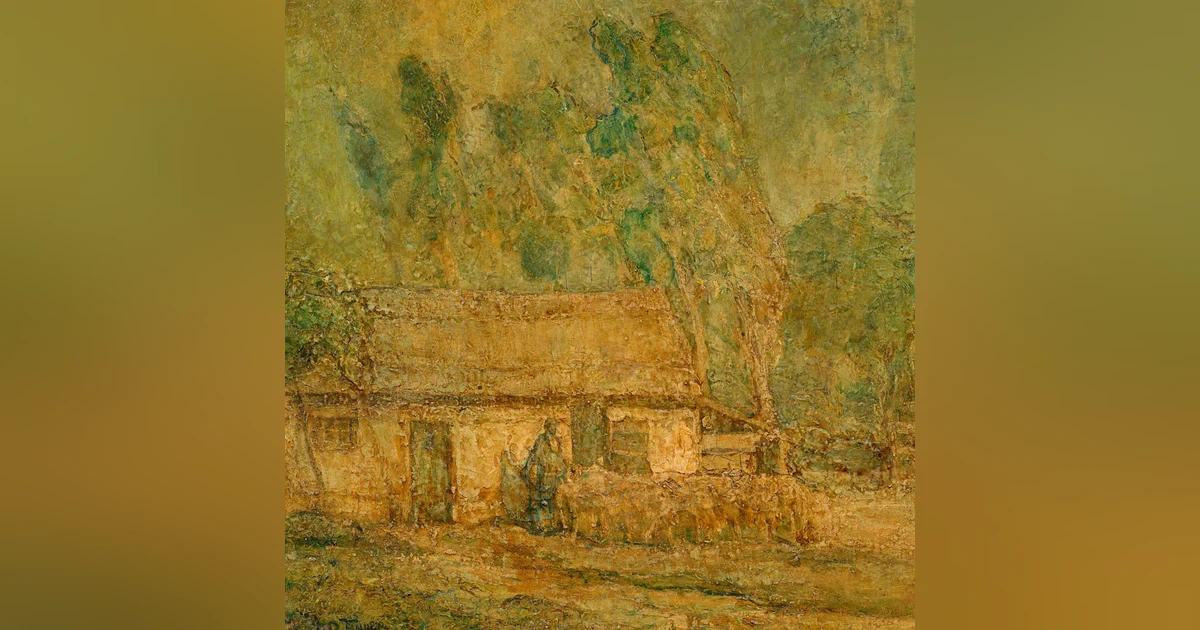
The Good Shepherd by Henry Ossawa Tanner


 Podcast Addict
 Overcast
Henry Ossawa Tanner became one of America's most famous Black artists by depicting dream-like Bible scenes like this one. Click here to see it on the Gallery's site. Clicking the image on their page will open a viewer that allows you to zoom in and pan around.
In today's episode we'll find out how he went from working in a flour mill to a successful artistic career in Paris and what he has in common with another artist, Richard Norris Brooke. And we discover a mystery about one of his early works!
SHOW NOTES
"A Long Look" theme is "Ascension" by Ron Gelinas youtu.be/jGEdNSNkZoo
Episode theme is "Virtutes Instrumenti" by Kevin MacLeod
Link: https://incompetech.filmmusic.io/song/4590-virtutes-instrumenti
License: http://creativecommons.org/licenses/by/4.0/
Artwork information
https://www.nga.gov/collection/art-object-page.195513.html
https://www.antiquesandthearts.com/henry-ossawa-tanner-and-his-influence-in-america/
Tanner Bio
https://www.nga.gov/collection/artist-info.1919.html
https://en.wikipedia.org/wiki/Henry_Ossawa_Tanner#cite_ref-eoaah_6-0
https://americanart.si.edu/artist/henry-ossawa-tanner-4742
Tanner painting technique
https://www.youtube.com/watch?v=hWxErF_nzd4
The post The Good Shepherd by Henry Ossawa Tanner appeared first on A Long Look.
Hello and welcome to A Long Look! A podcast about experiencing slow art at the National Gallery of Art in wdc. I’m your host, Karen J
Americans on average, spend about six to 10 seconds looking at works of art in museums.The slow art movement encourages people to slow down and spend more time with a work of art.
Now, this kind of looking can create more questions than answers. And that's where the fun starts—digging up information about the work and the artist. Later on in the show I’ll tell you what I find out!
So join me while I take a long look at works in the gallery’s collection.
MUSIC
Today I’m looking at The Good Shepherd by Henry Ossawa Tanner
If you want to follow along, you can find it on the gallery’s website, www.nga.gov.
So what do you first notice?
The glow of creamy golden yellow and delicate shades of green creating this dream-like scene. Everything’s indistinct, there are no clear details, just vaguely recognizable forms. So here’s what I see.
A shepherd stands outside a simple cottage with his flock of sheep huddled alongside him.
The cottage emerges from the left side of the canvas, near the lower corner, and extends about 2/3 of the way across. It has a sage green front door just left of center. To the left of that, a window sits high on the wall. A young tree sits right outside that left-hand window leaning to the left as it runs off the canvas. On the right side of the cottage, there appears to be another door or opening and a small lean-to extending off it, its roof slanted downwards. Maybe it’s a pen for the sheep?
The shepherd stands in front of that right-hand opening. He’s turned to our right facing his flock, almost in profile. He’s tall, his head almost reaches the sagging cottage roof. He’s painted in that same sage green, even his skin, with thin traces of emerald green delineating the folds of his voluminous cloak and the shadow along his chin. His features are vague, barely hinted at. An angled narrow band of green stands in for eyes and patches of caramel brown suggest a beard.
In contrast, the sheep are a mass of yellow, delineated by brown strokes and patches. The occasional white dot suggests an eyes, staring out at us. They form a pretty large group that stretches to the right of the shephed as far as the lean-to.
Sunlight from the upper right warms the scene and casts brown shadows under the eaves of the cottage and throws a faint watery green shadow of the shepherd onto the wall.
The ground in front, which fills the lower quarter of the canvas, is sketched in shades of green layered on each other that blend into areas of creamy gold and patches of caramel brown. Thick dabs of color suggest rocks and pebbles.
Tall trees rise up behind the cottage, their thin yellow trunks speckled with dark brown. They kind of melt as they rise, turning into watery blobs of emerald and sage green suggesting foliage. It almost looks like watercolor! Their branches reach towards a green-gold sky filling the upper third of the image. A vaguely round gold shape hovering over the cottage might be the sun. Like the tree out front, they lean to the left as if blown by steady wind over the years. Finally, a shorter tree fills the space between the cottage and the right side of the canvas.
Aside from the vague figures, what also gives this scene such a dreamy feeling is how Tanner applied this handful of colors. He built up layer after layer of dabs, blotches, dots, short strokes, thin trails of color, thick drops and strokes of impasto and in the sky, delicate washes of yellow and green. Some of these layers are translucent, there are a lot of places where the green is so thin, you can see the yellow through it. In others it looks like he used thick, loaded brushstrokes. The paint must be almost 3D in person! The effect is hazy, shimmering and mind-boggling!
So why would Tanner paint a Bible scene in such an unusual way?
MUSIC
Henry Ossawa Tanner was born in Pittsburgh, 1859. His dad, Benjamin Tucker Tanner, was a minister for the African Methodist Episcopal Church who later became a bishop. His mother, Sarah Miller Tanner, was a former slave who had escaped north on the Underground Railroad. The family eventually settled in Philadelphia, when Tanner was about 10. A few years later, while walking through Fairmount Park, he saw an landscape painter at work and decided he wanted to be a painter too.
Dad wasn’t too pleased, he hoped he’d go into the ministry or business. He set him up with a job at a friends’ flour mill but eventually Tanner convinced his parents to let him study art and enrolled in the Pennsylvania Academy of the Fine Arts when he was 21. He was the first full-time Black student there.
He studied with a prominent American artist, Thomas Eakins who taught him the importance of working from reality, from nature. That meant drawing and painting from live models, vs just copying plaster casts of classic statues, which was the usual Academy method.
Eakins also introduced him to photography and after he left the Academy, he moved to Atlanta to open a photography studio. The business didn’t work out but he did meet Bishop Joseph Crane Hartzell. Hartzell and his wife became his first patrons and Hartzell got him a job teaching art at Clark College.
The Hartzells were such fans they mounted an exhibition of Tanner’s work and ended up buying all the works in the show. This gave Tanner the money to finally go study painting in Europe. He was supposed to go to Rome but on the way, stopped in Paris and just loved it. It wasn’t just for the arts but as an escape from the racism at home. He enrolled in the Académie Julian and joined the American Art Students Club. He attempted a couple of times to return to live and work in America, but the prevailing racism and rise of Jim Crow laws, convinced him to return to Paris. There, he could focus on his art and live a freer life.
Tanner’s early works depicted the lives of African Americans he met while spending a summer in the mountains of North Carolina. Just like Richard Norris Brooke, he wanted to depict African Americans with dignity and humanity to counterbalance the caricatures that were so widespread.
But back in Paris, he began painting biblical scenes. It might have been because of his religious upbringing or because most artists tried this at one point in their careers. Religious or history paintings were considered more important than scenes of everyday life, so it was one way to grow your reputation.
Like every artist, he entered his works in the prestigious annual Salon. This was an opportunity to show his work to a large audience and kickstart his career. His first Bible painting, Daniel and Lions’ Den won an honorable mention in the 1896. A year later, his innovative version of The Raising of Lazarus won a third class medal and the French government bought it for display in the Musee du Luxembourg, bringing him even more fame.
BTW, there’s a mystery surrounding that first Daniel painting. Tanner did another version years later but that first one disappeared!
Tanner’s work got on the radar of Rodman Wanamaker. Wanamaker was a Philadelphia businessman who made his fortune in department stores. He saw The Rasing of Lazarus in Paris and was so impressed, he offered to pay for Tanner to go to see the Egypt and the Holy Land firsthand and learn how to more naturally depict the light, people and settings of these Biblical locations.
Tanner took him up on his offer and left in 1897, going to Cairo first. From there he traveled to Jerusalem, Jericho and the Dead Sea, making sketches of the people, mosques, architecture and landscape he encountered.
When he eventually headed back to Europe, he stopped in Italy where he finally got to see Rome!
Several years ago, Gwendolyn Everett gave a lecture at the Gallery where she tells the story of how Tanner found out his was famous. She said he was in Venice and a letter that had been following him around for three weeks finally caught up with him. It was an offer from the French government offering to buy his Lazarus painting. He also started getting letters from friends back in Paris telling him to come back to “see the crowds before your picture.” Needless to say, he went back immediately.
The Good Shepherd was painted in 1918, years after he had gained international recognition. He was working for the American Red Cross in Paris at the time, painting images of Black troops during WWI. A few years later, he was awarded France’s highest honor and named a knight of the Legion of Honor for his contributions.
And it was one of the founding pieces of the Evans-Tibbs collection. Madame Lillian Evanti, who we heard about in the introductory episode, bought it from Tanner while performing in Paris.
Although Tanner was trained to be a realist, the dreamy, hazy style of The Good Shepherd was probably inspired by the Symbolists, a group of poets and artists who wanted to convey the visionary and spiritual. They also were influenced by a color theory that said colors have emotional meanings and moods. This idea is still used in graphic and interior design. According to this theory the yellow and green Tanner used here stand for danger and hope. Since The Good Shepherd is a Biblical parable about a shepherd who leaves his flock to find one lost sheep, it makes sense!
His biblical scenes made Tanner an international art star. In 1908, he was given a one-man show at the American American Art Galleries in New York and spent the following years fielding offers from galleries around the country. Towards the end of his life, Tanner was made an academician of the National Academy of Design, a lifetime award.
OUTRO:
So this is what slow art is all about. Let the art kind of reveal itself. The Slow Art website recommends 5 to 10 minutes. I hope you’ll try this out when you can finally visit a museum and you can find more info at www.slowartday.com
You can find links to today’s information in the show notes at alonglook-slowart.com and in most podcast apps. While you’re there, why not subscribe and share? It’s free and that way you and your friends won’t miss an episode! You can find subscription links and social buttons near the end of each post.
By the way, do you have any comments or questions? Let me know! There’s a comment link at the end of each post.
Thanks for joining me!