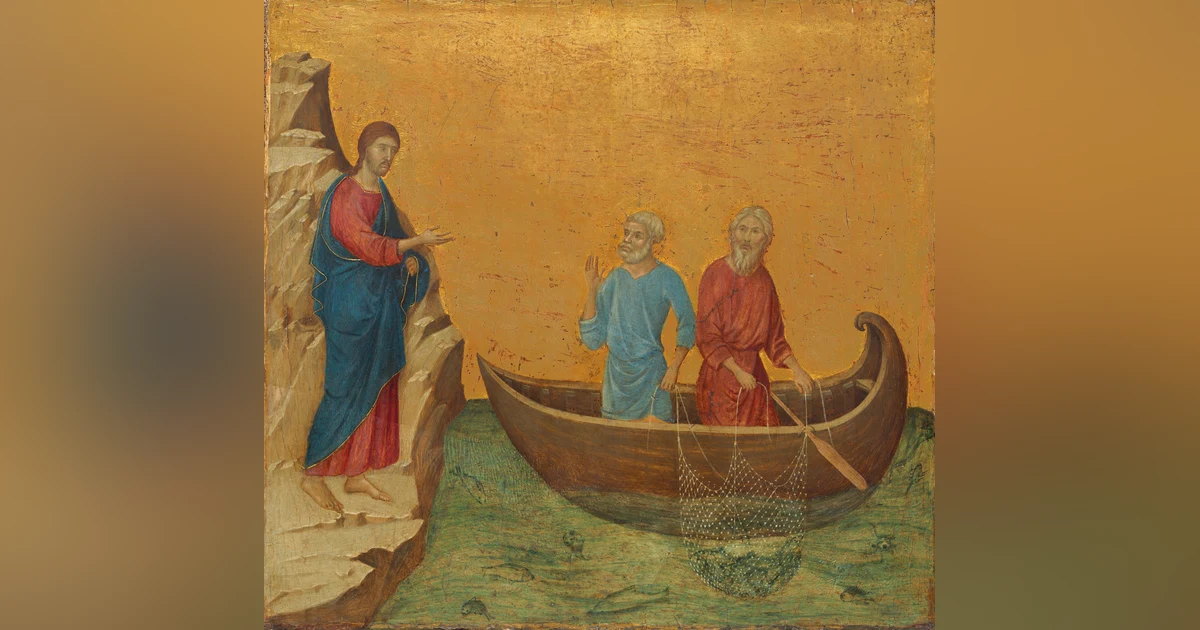
The Calling of the Apostles Peter and Andrew by Duccio di Buoninsegna


 Podcast Addict
 Overcast
This colorful panel painting depicts an episode early in Jesus's career–the moment he called Peter and his brother Andrew to join his ministry. It was part of an enormous altarpiece for the cathedral of Siena.
We'll find out what prompted the cathedral powers to hire Duccio, Siena's top artist and how innovative he was in depicting stories of Mary and Jesus's lives. And we meet a few friendly fish!
SHOW NOTES
"A Long Look" theme is "Ascension" by Ron Gelinas youtu.be/jGEdNSNkZoo
Episode theme is "Canzona 'La Foresta' (For 2 Trumpets and 2 Trombones – Rondeau)" composed by Giovanni Cavaccio. Performed by Michel Rondeau. Courtesy of musopen.org
https://musopen.org/music/33104-canzona-la-foresta/
https://musopen.org/music/performer/michel-rondeau/
Artwork information
Miklós Boskovits (1935–2011), "Duccio di Buoninsegna/The Calling of the Apostles Peter and Andrew/1308-1311," Italian Paintings of the Thirteenth and Fourteenth Centuries, NGA Online Editions, https://purl.org/nga/collection/artobject/282 (accessed May 17, 2020).
Maestà information
https://smarthistory.org/duccio-maesta/
https://operaduomo.siena.it/en/sites/museum/
Duccio information
https://www.britannica.com/biography/Duccio
The post The Calling of the Apostles Peter and Andrew by Duccio di Buoninsegna appeared first on A Long Look.
Americans on average, spend about six to 10 seconds looking at works of art in museums.The slow art movement encourages people to slow down and spend more time with a work of art.
Now, this kind of looking can create more questions than answers. And that's where the fun starts—digging up information about the work and the artist. Later on in the show I’ll tell you what I find out!
So join me while I take a long look at works in the gallery’s collection.
MUSIC
Today I’m looking at The Calling of the Apostles Peter and Andrew by Duccio di Buoninsegna
If you want to follow along, you can find it on the gallery’s website, www.nga.gov.
So what do you first notice?
The amazing gold sky filling the background of this Biblical scene. It takes up about two-thirds of the height of this panel painting.
Jesus stands barefoot on a rocky outcropping rising behind him. The jagged formation painted in tans and browns is piled up the left side of this wooden panel, almost reaching the top. He is tall and thin, with wavy chestnut hair cascading down the back of his neck. He has a short brown beard and moustache that outline his narrow face. He wears a long crimson garment with a steel blue cloak is layered over it. The cloak loops over his left shoulder, under his right arm and drapes over his left arm. The garment and cloak are bordered with thin strokes of gold. A halo circles his head and it’s filled with a pattern lightly carved into the gold leaf. Two curved scrolling lines face each other to form a heart shape and they alternate with chevrons and diamond shapes.
Jesus stretches out his right hand, gesturing towards two fishermen standing in a short, deep, latte brown rowboat who are about to haul in their catch. They are brothers, Peter and Andrew. Peter has turned toward Jesus with his right hand raised and a startled look. When I zoom in, I can even see the creases on his forehead! His chubby face is framed by a blond beard and moustache and very short hair. It looks like a bowl cut. His sky blue, long sleeved tunic is cinched at the waist. But as I kept looking at him, I realized his belt curves down around his waist, creating the hint of a pot belly! This is one of the great, humanizing touches Duccio was famous for. Andrew stands to Peter’s left, our right. He has his back to the other two, but is starting to turn around to see what’s happening. His hands are full with the strands of their net. He’s thinner than Peter and wears a brick red garment. He’s blond, like Peter, but his hair and beard are longer, the beard almost reaches his chest. Their boat and the water it sits in take up the bottom third and right side of the scene. The strong vertical of Jesus on the rocky shore, combined with this horizontal element forms an L shape.
The sea is an unusual copper green and several fish swim in its undulating current. They’re painted in sketchy dark green outlines and here’s my favorite thing. A couple have turned to look right at us with big dark eyes and gaping mouths, like they’re saying hello!
Their unfortunate colleagues are piled into the brothers’ net. It’s woven from thin crisscrossing strokes of white and where they meet is a small white dot. It looks almost too delicate for that load!
The gold leaf sky fills the rest of the scene but I think it even extends down behind the water. I could see peeks of gold through the loose strokes of green.
So where did this panel come from? And why does Peter look so surprised?
MUSIC
The panel depicts the moment Jesus calls to Peter and Andrew to be his first apostles. Peter, feeling unworthy, raises his hand in protest. But of course, they did join him.
It was part of the astounding Maestà, an altarpiece built for the cathedral of Siena. At 15 feet wide and probably about 17 feet high, it would have towered over the main altar.
An altarpiece is an architectural framework divided into sections that would hold panel paintings depicting scenes of the life of Jesus or Mary or whoever the cathedral or church was devoted to. There were usually some saints and prophets included. Duccio’s altarpiece, resembled the exterior of a Gothic church because of its top row of narrow pointed arches and thin carved spires. Just picture Chartres Cathedral, Westminster Abbey or even St. Patricks’ in New York!
Now a little background. For centuries, Italy was a collection of independent city-states, two of which were Siena and its neighbor Florence. They were really competitive and frequently at war.
The Siena cathedral was dedicated to the Virgin Mary who the Sienese believed had aided them in defeating the Florentines in a battle years earlier. So in 1308, Duccio, the leading artist in town, was commissioned to build a new altarpiece. And he did not disappoint. He created an incredibly elaborate narrative composed of about 75 panels covering the front and back of this enormous work. It was like a graphic novel of Christianity. No one had seen anything like it!
It was such a big deal when it was finished in 1311, the city staged a formal procession of clergy and civilian leaders carrying it from Duccio’s studio to the cathedral, accompanied by musicians. The city celebrated for three days, holding feasts and giving donations to the poor.
Gold and rich colors were everywhere on this thing. Gold leaf fills the background of each scene and everybody’s got a gold halo. Unfortunately, Peter and Andrews’s halos have faded over time. But just imagine how spectacular this must have looked in candlelight or sunlight streaming through stained glass windows!
Ok, so here’s the painful part. The altarpiece remained intact until the early 1500s when someone decided to divide it up and move the pieces to side chapels. What’s worse is in 1771 the whole thing was cut apart! The original framework was lost. The fragments were displayed around the cathedral but a lot were lost or sold over the years. Many ended up in museums in Europe and the US, including the Gallery. This is actually one of two the Gallery owns.
Because of the missing panels and lack of documentation, historians have had to make educated best guesses about how the altarpiece originally looked. So here’s what historians think it looked like. The centerpiece was a large rectangular painting of Mary and Baby Jesus sitting on a large marble throne. Rows of saints and angels spread out on either side and there’s a row of more saints above them. Under this main panel was a horizontal band called a predella. This was divided into 13 sections each showing either a prophet or a scene from Mary’s life. Along the top would have been those tall pointed arches, also painted with scenes from her life. Altogether, there were 32 images on the front.
The back of the altarpiece is even more elaborate. It was divided into 43 sections, showing scenes from Christ’s life, including this panel.
But the remaining pieces, including the big painting of Mary and Christ, were eventually reassembled and are now on display in a nearby museum, the Museo dell’Opera del Duomo.
OUTRO:
So this is what slow art is all about. You don’t have to see everything when you visit a museum. Just find a few pieces that catch your eye and let yourself really look closely. Let the art kind of reveal itself. The Slow Art website recommends 5 to 10 minutes. I hope you’ll try this out on your next museum visit and you can find more info at www.slowartday.com
Want to know where I get my information? The Gallery’s website is my main source but I use others as well. You can find links in the show notes on the show’s website, alonglook-slowart.com and in most podcast apps. While you’re there, why not subscribe and share? It’s free and that way you and your friends won’t miss an episode! You can find subscription links and social buttons near the end of each post.
By the way, do you have any comments or questions? Let me know! There’s a comment link at the end of each post.
Thanks for joining me!