The Apostle Judas Thaddeus


 Podcast Addict
 Overcast
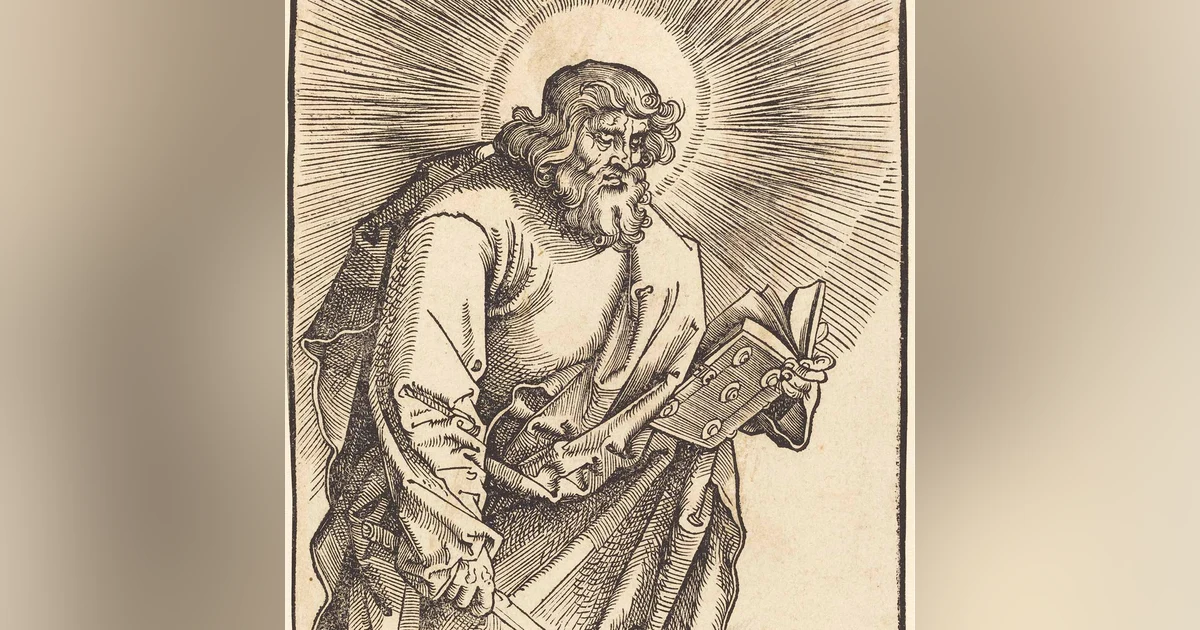
Talk about a bad rep. Poor Judas Thaddeus has had to contend with the shame of being confused with Judas Iscariot, the traitor who sold out Jesus for 30 pieces of silver. But somewhere along the line he was rebranded as St. Jude, the patron saint of hopeless causes. He's so popular, he's even the namesake of St. Jude's Children's Research Hospital which is devoted to treating children with cancer and finding a cure.
In today's Long Look we'll find out about the artist who created this print, Hans Baldung Grien and get a crash course on woodblock printing!
SHOW NOTES
Please visit alonglookpodcast.com
"A Long Look" theme is "Ascension" by Ron Gelinas https://youtu.be/jGEdNSNkZoo
Episode theme is "Missa Et ecce terræ motus - I. Kyrie - Christe - Kyrie." Performed by Steve's Bedroom Band https://musopen.org/music/31674-missa-et-ecce-terr-motus/
Artwork information https://www.nga.gov/collection/art-object-page.676.html
Artist bio https://www.nga.gov/collection/artist-info.323.html
St. Jude information
https://www.stjudeshrine.org/sj/patron-saint-of-the-impossible/
https://www.catholic.org/saints/saint.php?saint_id=127
https://www.britannica.com/biography/Saint-Jude-Apostle
History of woodcuts in the West
Thompson, Wendy. "The Printed Image in the West: Woodcut." In Heilbrunn Timeline of Art History. New York: The Metropolitan Museum of Art, 2000–. http://www.metmuseum.org/toah/hd/wdct/hd_wdct.htm (October 2003)
How woodcuts are made (video)
St. Jude's Children's Research Hospital https://www.stjude.org/
Did you know most people spend only a few seconds looking at works of art? But what happens if you slow down and take a long look? For the next 5 episodes, we’ll be doing this virtually, at museums with great online resources. We’ll start at the Gallery but will check out works at museums across the country.
So join me for a long look in the National Gallery of Art in Washington DC!
MUSIC
Today I’m looking at The Apostle Judas Thaddeus by Hans Baldung Grien BALDOONG GREEN
If you want to follow along, you can find it at alonglookpodcast.com/judas. When you get there, just click on the image to zoom in and pan around.
So what do you first notice?
The intense focus of the apostle as he strides in from the left side of this letter-sized print. His head and eyes are tilted down to a large open book cradled in his left hand and braced against his waist. He’s a big guy, tall and heavyset, almost taking up the whole height of the image and most of the width. He’s stooped slightly, gripping a gnarled heavy club in his right hand that almost touches the ground. His bare left foot is stepping forward while his right is turned towards us. The head of the club is swung forward a little, lining up with that left foot.
We’re looking at a woodcut today, which is a type of printing that results in an image that looks like a black and white line drawing. In this case, it was printed with dark grey ink on tan paper.
A sort of super halo bursts from his head. An inner circle of short strokes is offset from his head by several inches and is surrounded by an enormous outer circle of longer tightly spaced strokes that fill the space above and behind him, flying off the top and sides.
Thick wavy hair falls to his shoulders, merging with an equally long, thick, and wavy beard and moustache.
He’s really concentrating on that open book, gazing at it with downcast eyes and a slightly open mouth. We can see its back cover. It looks heavy and thick, created with dense parallel horizontal lines and decorated with raised ovals in each corner and one in the middle.
He wears the usual Biblical outfit--an ankle length loose robe covered by a wide mantle draped over his left shoulder and down across his chest, winding around his waist. The elaborate, numerous folds and creases of his garments are delineated by areas where the lines are packed close together and sometimes criss cross. The denser they are, the darker the shading. The highlights are created by blank areas where there are no strokes. So for example, part of his right arm, shoulder and chest are blank but around them are these stroked areas creating the shadow under his beard, the folds going under his arm, and the shadow at the waist where he bends a little. The folds of the mantle hanging down his back are delineated by kind of fragmente d planes of lighter and darker shading.
The patch of ground he stands on is suggested by tightly packed thin curved lines spreading across the lower eighth of the image. A small mound with a tuft of long pointy grass rises just behind and above his left foot and and the club head. BTW, that club head is pretty large. For you golfers out there, it reminds me of a Big Bertha driver!
Judas, his enormous halo and the grassy ground almost fill the entire scene. But there’s a blank area on the right side, above the mound, below the halo and in front of the apostle. Floating in it is Hans’s monogram and here’s what it looks like: Imagine a capital H and a B, now merge them so the right side of the H shares the vertical stroke of the B. Now hang a smaller capital G on the H’s cross bar and finish with a dot on either side of the H and B. And there you have it.
The entire image is enclosed by a thick border.
MUSIC
Hans Baldung was a German artist during the Renaissance. He was a student of Albrecht Dürer, one of the leading artists at the time. Grien wasn’t really his last name, it was actually a nickname he was given. Apparently there were several Hanses in Durer’s workshop, so they started calling him Grien because he either wore a lot of green or painted with a lot of green! Working for Dürer was a masterclass, teaching him how to produce engravings and woodcuts like this one but also how to design for stained glass and how to run a workshop.
After just four years, Hans left to go out on his own. He received a couple commissions for altarpieces, got married, joined a guild and started his own workshop in Strasbourg. Except for one four-year project that took him out of town, Hans spent the rest of his life there. Judas Thaddeus was done in 1519, just a couple of years after his return and was part of a series called Christ and the Apostles.
Judas Thaddeus is not that Judas, the villain of the story of Jesus. If you don’t know the story, Jesus Christ assembled 12 followers while he traveled and preached. Judas Thaddeus was one of these original twelve apostles. Judas Iscariot was another. Jesus got to be pretty famous, drawing the attention of the authorities. Things came to a head when he and the apostles entered Jerusalem to a wildly cheering crowd. Judas Iscariot decided to turn Jesus over to the authorities for 30 pieces of silver. Jesus was arrested, brought before the Roman and local authorities and condemned to death for his teachings. The rest you’ve seen in Western artworks going back centuries--the beatings, crucifixion and resurrection. Judas Iscariot, realizing what he’d done, hangs himself.
Judas Thaddeus was later renamed St. Jude to avoid confusion with the traitor Judas. And he became the patron saint for hopeless causes. The official explanation from the Church is that St. Jude was martyred during his own mission and brought back to Rome to be buried in St. Peter’s Basilica. Pilgrims who prayed at his tomb claimed that because of his powerful intercession in presenting their cases to God, their impossible prayers were answered.
There’s even a famous children’s hospital named after him, devoted to treating and finding cures for cancer. It’s called St. Jude Children’s Research Hospital. I’ll include a link in the show notes.
The woodblock is one of the earliest forms of printmaking. It began in 8th century Japan and was originally used for printing patterns onto textiles.
Here’s how it works. Imagine a thin plank of wood. An image is drawn onto the flat side or a drawing on paper is attached to it. Then a block cutter uses tools to carefully carve away the areas around the lines of the drawing. So what’s left is the raised image sticking up from the surface of the plank. That raised image is covered with ink and the block is placed on a press with a damp sheet of paper over it. That is run through the press and voilá, you have your print.
Woodcuts had become more sophisticated by the Baldung’s BALDOONG time, mostly because of the innovations by his teacher, Dürer. They were used as illustrations in early books as well as standalone prints. And these books became a communications revolution, like the Renaissance version of the Internet. Suddenly medical, scientific, religious, and political ideas could travel relatively easily throughout Europe, the Middle East and Asia.
The Metropolitan Museum of Art has a great video on how woodcuts are made. I’ll include a link in the shownotes.
In the end, Hans did alright for himself. By the time he died in his early 60s, he was a member of the city council and one of Strasbourg’s richest citizens.
OUTRO:
I hope you’ll try out a long look on your next museum visit! You can find links to today’s information in the show notes at alonglookpodcast.com and in most podcast apps. While you’re there, you can leave a comment or ask a question. I’d love to hear from you.
You can find links to follow A Long Look on the website or your favorite podcast app or streaming service.
Thanks for joining me!