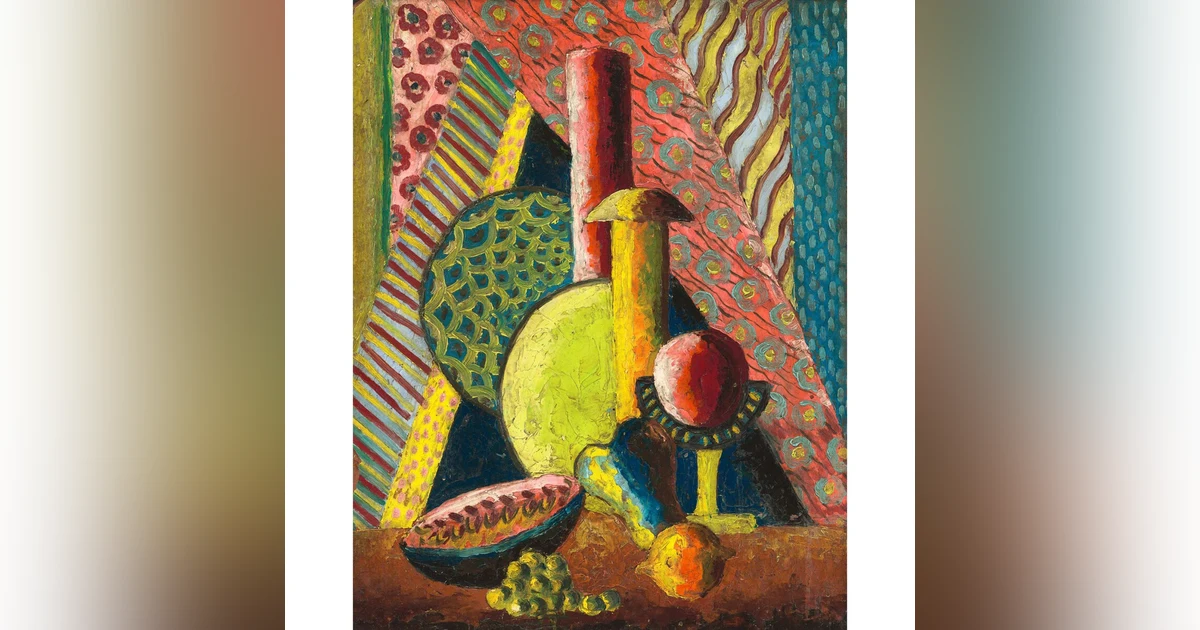
Still Life by Margaret Burroughs


 Podcast Addict
 Overcast
Margaret Taylor Burroughs was an author, painter, sculptor, printmaker, curator, museum director, activist, and teacher who left an amazing artistic and historic legacy in Chicago. In today's episode we'll find out how she helped launch the Chicago Renaissance in the '40s and how she combined her social activism with art.
"Still Life" by Margaret Burroughs, American, 1943
Corcoran Collection (The Evans-Tibbs Collection, Gift of Thurlow Evans Tibbs, Jr.)
SHOW NOTES
"A Long Look" theme is "Ascension" by Ron Gelinas youtu.be/jGEdNSNkZoo
Episode theme is "Shades of Spring" by Kevin MacLeod
Link: https://incompetech.filmmusic.io/song/4342-shades-of-spring
License: http://creativecommons.org/licenses/by/4.0/
Cain, Mary Ann, and Haki R. Madhubuti. South Side Venus : the Legacy of Margaret Burroughs Evanston, Illinois: Northwestern University Press, 2019.
Link to materials on Margaret Burroughs at the NGA Library
The Southern University Fine Arts Department Presents Dr. Burroughs., n.d.
You Are Cordially Invited to an Exhibition of New Paintings by Dr. Margaret Burroughs., 1992.
Margaret Burroughs, Marion Perkins : A Retrospective. Washington, D.C. (1910 Vermont Ave., N.W., Washington 20001): Evans-Tibbs Collection, 1982.
Samples of Burrough's later works
The Woman Who Helped Birth a Black Artistic Renaissance in Chicago (Vice article)
Margaret Burroughs, co-founder of DuSable Museum, dies at 95
Wikipedia entry
Linocut printmaking video
Americans on average, spend about six to 10 seconds looking at works of art in museums.The slow art movement encourages people to slow down and spend more time with a work of art.
Now, this kind of looking can create more questions than answers. And that's where the fun starts—digging up information about the work and the artist. Later on in the show I’ll tell you what I find out!
So join me while I take a long look at works in the gallery’s collection.
MUSIC
Today I’m looking at Still Life by Margaret Burroughs
If you want to follow along, you can find it on the gallery’s website, www.nga.gov.
So what do you first notice?
Strong light streams in from the left of this poster sized painting and illuminates a group of shapes and fruit that form a rough pyramid. They sit on a chocolate brown surface or table filling the lower eighth of the painting. The tallest shape is a red cylinder that sits in the center and almost reaches the top. You get the sense of its volume by how it’s painted, running from a white highlight on the left to scarlet in the middle, then a cranberry red shadow.
Below and to the right of it is a shorter cylinder. This one though is topped with a semi circle that looks like a mushroom cap. It’s butter yellow blending to orange then to spinach green shadow. Each cylinder has a partial circle emerging from the its left side. The one next to the yellow cylinder is chartreuse bordered in dark grey. The other is filled with a peacock pattern.
In front of all this are fruits scattered left and right to complete the pyramid. On the left is an oval shaped melon cut in half. Its skin is a bluish black and its flesh is a rosy pink, studded with two parallel rows of seeds. A cluster of green grapes is draped in front of it and nearby is a pomegranate. It’s almost pumpkin orange highlighted with a warm golden yellow.
An upside down anjou pear sits between the melon and pomegranate, tilted a little to the left. Its left side is chartreuse with flicks of blue blending into a cobalt blue then black on the right.
The last object is a sort of vessel. Imagine a cross between a horseshoe and a chalice and you’ll get the idea. A red apple is nestled in its curve which is black decorated with alternating strokes of cobalt blue and yellow. Its stem and base are chartreuse.
Pattern plays a huge role in this painting. The whole background behind the group is filled with angled shapes filled with different ones. They remind me of bolts of cloth on display.
Starting from the left, a silver parallelogram covered with alternating burgundy and yellow stripes angles up from the table on the lower left and ends to the left of the red cylinder. A smaller yellow copy of it, dotted with pink, is tucked along its right edge.To its left, an upside down pink right-angle triangle drops down from the top edge of the painting. Quick circles of red with dark blue dots in the center suggest flowers. A narrow band of olive green fills the rest of the left side, suggesting a wall.
On the right, another angled shape rises from the table and intersects the silver shape just to the left of the red cylinder. The gap where they meet forms a triangle the same blue black as the melon. This rising shape is coral, covered with thin black squiggles and light blue circles with yellow dots. To its right, another upside down right angle triangle drops from the top. It’s light grey and covered with broad, wavy yellow shapes, outlined in chocolate brown. It’s flipped to mirror the pink triangle. Finally, the rest of the right side is filled cobalt blue dotted with faint dabs of grey and brown.
Aside from being so colorful, these patterns are painted very loosely which makes it vibrate with energy. It’s very Cubist in style and while I’ve described things as being behind one another, you could also say they interlock, like a puzzle.
MUSIC
Margaret Taylor Burroughs was born in Louisiana in 1917. Her family moved to Chicago when she was 5, and was her home for the rest of her life. She earned a bachelor’s and master’s degree in art education from Chicago Teachers College and the The School of the Art Institute of Chicago.
Still Life was done in 1943 while she was in her 20s. It’s an example of her arts training at the Art Institute, where students learned modern styles like Cubism and expressionism. And it’s another piece in the Evans-Tibbs collection. Like Thurlow Evans Tibbs, Burroughs became focused on “the uplift of African American and Africans including the diaspora.”
She lived and worked at a time when a lot of Black women in Chicago were very involved in social activism and devoted her public life to art, teaching and community organizing. She spent 23 years teaching art in DuSable High school and 10 years teaching humanities and art history at Kennedy-King College and Elmhurst College.
Just a few years before Still Life, she founded the South Side Community Art Center. The Center helped fuel a Chicago Black Renaissance in the 1940s, like the earlier Harlem Renaissance in the ‘20s. Black writers, dancers, composers and artists now had a safe place to come together to talk, learn and practice their art. The center was originally funded through the Works Progress Administration and its opening was attended by the first lady, Eleanor Roosevelt and broadcast nationally on the radio. Another guest was Alain Locke, an enormously influential professor from Howard University.
Early in her career, Burroughs realized she could either use her art to just make money painting trendy abstract pieces like Still Life or she could create more representative art that would benefit her fellow Black citizens. She wanted to reach them, not an art elite. So she began creating linoleum block prints which everyone could afford. Instead of cold, geometric compositions, these bold black and white prints depict the lives of the Black community around her and images illustrating African heritage.
She also created works of racial harmony saying, "I wish my art to speak not only for my people-but for all humanity. My subject matter is social commentary and seeks to improve the condition of life for all people"
Preserving and promoting Black heritage was a passion for her. She once told The Chicago Defender, “Service and humanity is what’s important. You should always want to honor and help others, and leave a legacy of something positive you’ve done in your community.”
To that end, she and her husband Charles founded the Ebony Museum of Negro Art in their home, featuring their extensive collection of masks, fabrics and other artifacts gathered during visits to Africa. Several years later, the museum was renamed DuSable (DOO-SAH-BUL) Museum of African-American History and moved to a new location in the city, becoming the first museum of its kind in the country.
She was proud the museum grew out of the Black community. She said, “We weren't started by anybody downtown; we were started by ordinary folks."
Margaret Taylor Burroughs was an author, painter, sculptor, printmaker, curator, museum director, activist, and teacher who left an amazing artistic and historic legacy. She even served as the Chicago Parks Commissioner after her teaching career!
This is just an introduction to Burroughs. Go check out the links in the show notes to find out more about this remarkable woman.
OUTRO:
So this is what slow art is all about. You don’t have to see everything when you visit a museum. Just find a few pieces that catch your eye and let yourself really look closely. Let the art kind of reveal itself. The Slow Art website recommends 5 to 10 minutes. I hope you’ll try this out on your next museum visit and you can find more info at www.slowartday.com
Special thanks goes to Anna Tomlinson and Anne Simmons at the Gallery’s Art Library for their invaluable help with today’s episode.
You can find links to today’s information in the show notes at alonglook-slowart.com and in most podcast apps. While you’re there, why not subscribe and share? It’s free and that way you and your friends won’t miss an episode! You can find subscription links and social buttons near the end of each post.
By the way, do you have any comments or questions? Let me know! There’s a comment link at the end of each post.
Thanks for joining me!