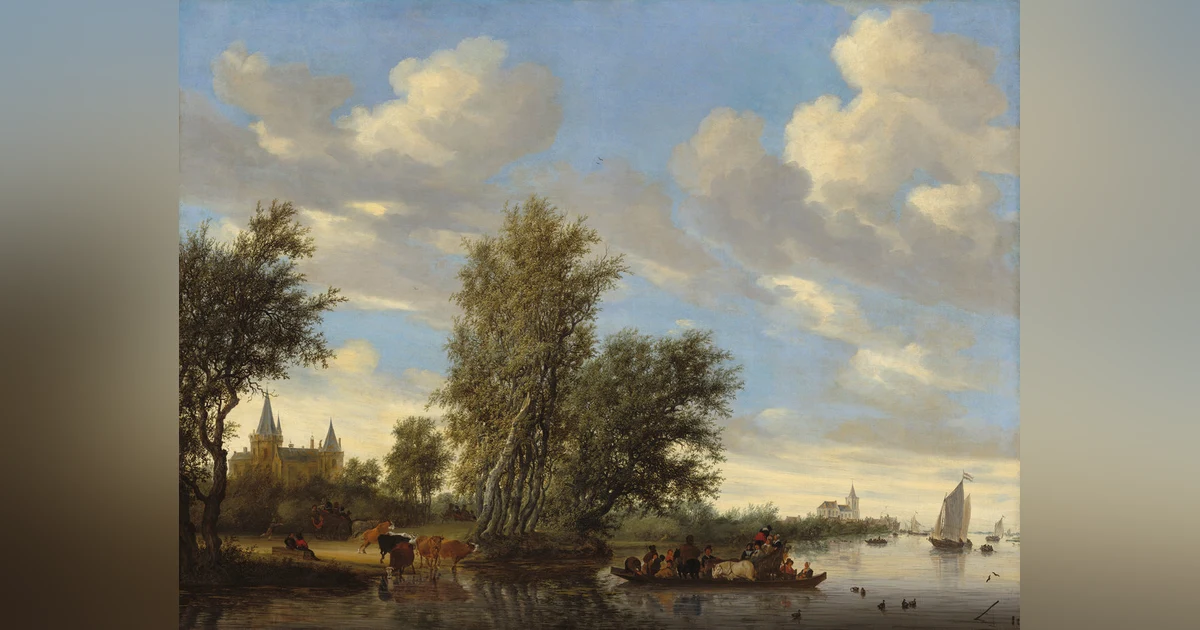
River Landscape with Ferry by Salomon van Ruysdael


 Podcast Addict
 Overcast
Salomon van Ruysdael absolutely nails the feeling of optimism, enjoyment, maybe even relief, as his fellow Dutch citizens ferry across a river on a soft spring evening. They're setting out to explore their hard-won, brand new Dutch Republic. You might remember from a previous episode about their war for independence against Spain, they spent 80 years fighting for this moment.
We'll find out the ferry might have meant more than just transportation to these folks and how it came to the Gallery after a long restitution battle.
SHOW NOTES
"A Long Look" theme is "Ascension" by Ron Gelinas youtu.be/jGEdNSNkZoo
Episode theme is "The Four Seasons, Op. 8" composed by Antonio Vivaldi. Performed by the Modena Chamber Orchestra
https://musopen.org/music/performer/the-modena-chamber-orchestra/composer/antonio-vivaldi/
Artwork information
Arthur K. Wheelock Jr., "Salomon van Ruysdael/River Landscape with Ferry/1649," Dutch Paintings of the Seventeenth Century, NGA Online Editions, https://www.nga.gov/research/publications/online-editions/dutch-paintings-seventeenth-century-river-landscape-ferry
Salomon van Ruysdael information
https://www.nga.gov/collection/artist-info.18427.html
Goudstikker restitution
https://www.sfgate.com/entertainment/article/Jacques-Goudstikker-s-recovered-art-2452469.php
https://www.nytimes.com/2007/02/22/arts/design/22heir.html
The post River Landscape with Ferry by Salomon van Ruysdael appeared first on A Long Look.
Americans on average, spend about six to 10 seconds looking at works of art in museums.The slow art movement encourages people to slow down and spend more time with a work of art.
Now, this kind of looking can create more questions than answers. And that's where the fun starts—digging up information about the work and the artist. Later on in the show I’ll tell you what I find out!
So join me while I take a long look at works in the gallery’s collection.
MUSIC
Today I’m looking at River Landscape with Ferry by Salomon van Ruysdael. (Rouse-dahl)
If you want to follow along, you can find it on the gallery’s website, www.nga.gov.
So what do you first notice?
A gorgeous evening sky almost fills this large canvas. It’s about 3 ft wide by 4.5 ft high. Puffy clouds drift in from the upper left of the azure sky and stretch back towards banks of thinner, flatter clouds receding towards the lower right. Their tops are white, illuminated by the setting sun with steel grey shadows on their undersides.
The sky hangs over a lively river scene. It’s divided roughly in half, with the river coming in from the right side and angling down to the lower left as it flows towards us. Its blue silver tone becomes a dark grey as it gets closer, spreading to fill the width of the lower edge.
A soft green spring landscape comes in from the left, paralleling the river’s angle and recedes as it reaches a town on the horizon. It takes up the lower quarter of the canvas.
In the foreground, just left of center, is a large group of people and animals packed into a wide, shallow ferry that’s just about to land on the left bank. Incredibly, there’s even an open carriage with sloped slides filled by 3 well-to-do looking couples. Imagine Santa’s sleigh with wheels and a lot less bling. It's harnessed to two horses, one white, the other chocolate brown. The men wear olive green jackets trimmed with a vertical strip of leather down the front, studded by a row of silver dots. The women all wear black with white kerchiefs. Two have black hoods and one standing in the back, wears a wide crimson sash wrapped around her hips. Sitting behind them in the stern, a more simply dressed woman nurses her infant while her husband looks on. The bow is filled with a knot of men and even a guy on horseback! They all wear earth tones and tall, wide-brimmed hats, except for one holding the horse. He’s got a bright scarlet tunic. Some face away, others face us but the odd thing is their faces are unfinished. They’re just blobs of color with black dots for eyes.
They’re approaching a clearing next to a cluster of tall trees with thick gnarled trunks that leans over the left bank, overhanging the water. Ruysdael does this great thing with them. Their rough branches are flecked with strokes of grey and moss green, and they’re covered with layers of tiny sage and moss green leaves. The one closest to us is lighter grey with its top half broken off. These techniques make the trees just shimmer in that evening light.
The ferry is heading towards a clearing to the left of the trees. At the water’s edge between us and the clearing is a group of 6 cows. Two of whom are... doing what cows do in springtime! The clearing continues behind and left of the trees, carpeted in light green and gold. It’s framed by another tall, solitary tree emerging from the shadows on the lower left, painted in shades of brown. At the back it’s bordered by tall hedges and another cluster of trees. Behind them is what looks like a small castle--two ochre yellow buildings with three pointed towers, all with slate grey roofs. Several chimney are scattered among them, silhouetted against the clouds.
There’s other activity in the clearing. Two men sit on a wooden bench with their backs to us, facing each other in conversation. One is dressed in black while his companion wears a crimson tunic tucked into black pants. He wears a large, wide brimmed hat.
Two more sleigh-like carriages filled with passengers head away from us, leaving the clearing and following the curve of the hedges. The one in front is partially obscured by a low rise right behind the trees. A young boy runs after the last one with his arm outstretched. Looks like he’s trying to catch up to his friend, who’s hanging onto the back, trying to sneak a ride! My guess is they’re heading to that distant town on the river’s edge.
They might be following a road hidden by the low blue green treeline running along the riverbank from the clearing to the town. A large white church rising over shorter buildings. We can just see their rooftops peeking over the trees and a wisp of smoke rising from one of them.
The gleaming river is bustling with ships and more ferries, some shadowed by the clouds overhead. A handful head our way, others towards the town. They all have billowing striped beige sails, topped by flags snapping in the breeze. A large Dutch flag waves from the one closest to us. Charcoal grey ducks float peacefully here and there and a couple of small birds skim the rippling water.
Ruysdael does a gorgeous job with the reflections in the water, which are incredibly realistic. The boats, trees, cows, even the sky, have these glassy rippling counterparts.
The massive sky, gorgeous light, soft shadows and colors, and everything silhouetted against those clouds makes this scene really peaceful, despite all the activity.
So where is everybody going?
MUSIC
They are out exploring their very own, brand new Dutch Republic. As I’ve mentioned in previous episodes, the Dutch had been under Spanish rule for ages and fought an 80 year war for independence. When they finally secured their freedom in 1648, they hit the road...and the waterways! They could finally travel without worrying about attacks by marauders or foreign troops. A lot of people went east to explore cities along the Rhine River that had played major roles in forming the Republic.That might be where Ruysdael got the idea to include a castle when he painted this a year later.
Ruysdael loved painting river scenes and all the lively activity taking place along them: gliding sailboats, fishermen casting nets and people crammed onto a ferry, like this. But ferries might have had more meaning that just transporting happy travelers. They were a place where people from all levels of society came together. So sometimes they were used as symbols for a united community.
Unfortunately, this happy painting does have a dark chapter in its history, involving the Nazis. A Jewish art dealer, Jacque Goudstikker, (Jake Godstikker) bought it in 1930. His gallery in Amsterdam specialized in Old Master paintings. Goudstikker was a big fan of Ruysdael’s and even arranged the first solo show of his work. However, in 1940, Goudstikker and his family fled Amsterdam, right before the Nazis invaded the Netherlands. The Nazis took over his gallery which contained about 1400 works. River Landscape, along with several others, ended up in the hands of Hermann Goring.
The Goudstikkers were able to escape by ship to Britain, but sadly Jacque had a fatal accident onboard.
The Allies recovered the painting after the war and gave it to the Dutch government. For some reason, the government didn’t return it to the family but ended up hanging it in the Rijksmuseum. The family fought for years for its return and finally in 2006, the government returned the painting to Goudstikker’s heirs. The family sold it to the Gallery in 2007.
OUTRO:
So this is what slow art is all about. You don’t have to see everything when you visit a museum. Just find a few pieces that catch your eye and let yourself really look closely. Let the art kind of reveal itself. The Slow Art website recommends 5 to 10 minutes. I hope you’ll try this out on your next museum visit and you can find more info at www.slowartday.com
Want to know where I get my information? The Gallery’s website is my main source but I use others as well. You can find links in the show notes on the show’s website, alonglook-slowart.com and in most podcast apps. While you’re there, why not subscribe and share? It’s free and that way you and your friends won’t miss an episode! You can find subscription links and social buttons near the end of each post.
By the way, do you have any comments or questions? Let me know! There’s a comment link at the end of each post.
Thanks for joining me!