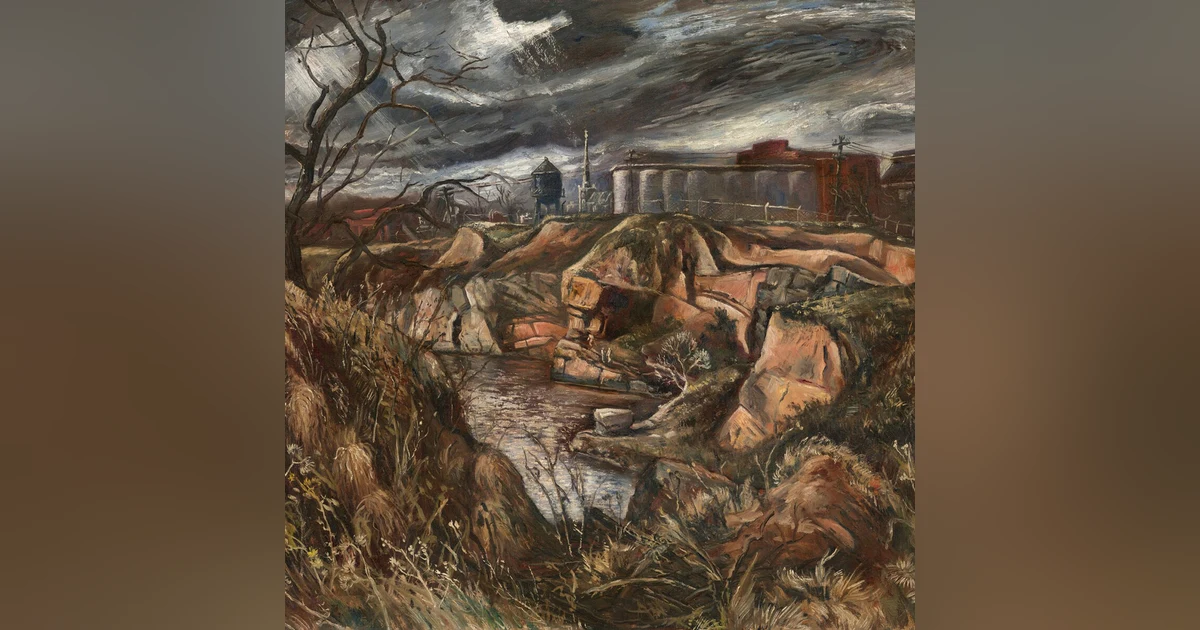
Quarry by Edward Loper


 Podcast Addict
 Overcast
We'll find out how his lifelong curiosity, study, and teaching built a successful career lasting more than 60 years.
You can see Loper's beautiful illustrations for the Index of American Design on the American Drawings page on the Gallery's site. The Index is listed in the sidebar. You can get a version to zoom and pan around in here.
SHOW NOTES
"A Long Look" theme is "Ascension" by Ron Gelinas youtu.be/jGEdNSNkZoo
Episode theme is "Night on the Docks – Sax" by Kevin MacLeod. Licensed under a CC-BY Creative Commons Attribution License.
Artwork Information
https://www.nga.gov/collection/art-object-page.176358.html
Gaudiano, N. (2009, Nov 19). Bidens' New Home a Gallery for Delaware Art. Gannett News Service (PDF)
Retrieved from https://search-proquest-com.dclibrary.idm.oclc.org/docview/450231157?accountid=46320
Exhibition catalogs
The Art of Edward L. Loper, Sr: On the Path of the Masters, University Museums of the University of Delaware, 2007
Edw. L. Loper: From the Prism's Edge, Delaware Art Museum, 1996.
Interviews
Oral history interview with Edward L. Loper, 1964 Mar. 26
Edward Loper : African American Painter (Video)
Edward Loper: Prophet of Color (Video)
The post Quarry by Edward Loper appeared first on A Long Look.
Most people spend only a few seconds looking at works of art. But what happens if you slow down and take a long look? Let’s find out with a work in the National Gallery of Art!
MUSIC
Today I’m looking at Quarry by Edward Loper. If you want to follow along, you can find it at the Gallery’s website, www.nga.gov.
So what do you first notice?
A stormy sky swirling with bands of smoke grey, white and steel blue clouds fills the top third of this oil painting. These swirls ripple as they move down and back into the distance on the canvas, which is about 2 ft by 2.5 ft., so almost square.
Thin streaks of white stream downward from the upper left. They seem to be streaks of light breaking through the gloomy clouds. That light illuminates a sort of industrial scene. Just left of center is a charcoal grey water tower and to its right, is a row of 7 large silos, connected along the top. There’s a gap between the tower and the silos where a distant church is tucked between them, its thin spire rising up towards the stormy sky. It’s ghostly looking, almost the same grey as the sky and outlined in strokes of white.
The silos back up to a red brick building. We can see a part of its roofline and right side. Further to the right is another structure with a steeply pitched dark brown roof that kind of looks like a barn. The silos and the barn are both painted in steel grey, with gleaming highlights from that light in the upper left.
In front of these buildings are a row of telephone polls and a chain link fence, painted with delicate horizontal and crisscross strokes of white and taupe. As it stretches left to right it follows the rough contours of a rocky landscape.
The landscape sits between us and those buildings. A series of rocky hills start below and to the left of the watertower, stretching down and to the right til they run off the canvas. The landscape continues in the foreground. It flattens a little where we’re “standing,” then climbs halfway up the left side The hills are covered in dark green moss and grassy dark brown, green and tan overgrowth. Their craggy faces are painted in ochre, stone beige and dark brown, delineated with angled strokes of black. A gleaming silver grey stream meanders towards us between those hills in the middle distance and the one to our left.
One scrubby, ghost white tree clings to one of the lower slopes near the water. And as I kept looking at it, I suddenly saw three tiny figures walking up a rocky path from the water! One looks like he’s heading for a tall brown patch on the face of the central hill that could be the mouth of a cave. He’s bent over, looks like he’s wearing a backpack while his companions remain standing near the water.
On the hill beside us is a gnarled tree, leaning a little to the right. Its dark bare branches stretch up and out, just brushing the top and left sides of the canvas. Two smaller similar trees sit on either side of it. They’re all painted in tones of charcoal grey and dark brown, highlighted with touches of white.
Through their branches, I see another barn in the distance, this time russet red, like an autumn leaf. The mood of this scene is definitely autumnal, almost wintery. It reminds of late November when colors have faded and the wind whips around you.
MUSIC
Edward L. Loper was a native of Wilmington Del and Quarry is one of many scenes of the city he painted over a career that lasted more than 60 years.
He started out when he was 20, struggling to find work during the height of the Great Depression in the 1930s and 40s. He was hired by the Works Progress Administration to work on a project called the Index of American Design. The Works Progress Administration was the US government’s massive program that provided jobs to millions of people during the Depression. In addition to the Index, artists, including Black artists, were hired to create paintings, sculptures and murals for public buildings.
In a 1964 interview, Loper explains how he got job because of his wife, quote: “So, finally my wife gave up the idea of trying to make it by ourselves and she went up to see about some form of help and while there she met a lady and they were discussing...they needed people for art projects...she told this woman, whoever it was, that I had painted. So, they said to send him in...‘rather than giving him a job on relief, we'll give him a job on something we need.’" end quote.
He‘d taken art classes in high school but didn’t have formal training. But he interviewed anyway and got the job. He and three other men were put to work making detailed illustrations of folk art objects found in American homes since colonial days. This was a way of preserving American decorative arts that were in danger of disappearing. These included toys, metalwork, furniture...
The drawings are beautiful, really detailed and the collection lives at the Gallery. I’ll include one in the post.
He credited working alongside these trained artists for really bolstering his illustration skills. Their day ran from 9-1:30 and every day after work, he’d go outside and paint.
Loper got into painting when he saw works by N.C. Wyeth displayed in Wilmington store windows. He talked to Wyeth who encouraged him to learn by looking at other artists. So he started going to the Wilmington Library every day to see their collection.
Loper was invited to join the Easel Project run by Walter Pyle. This was the part of the WPA that hired artists to paint murals and other works for public buildings. He focused on painting outdoor scenes of Wilmington and really liked working for the easel project. He said, “With easel painting you painted as much as you wanted. In fact, you painted more but you were doing something more exciting.”
Loper and his colleagues on the Project talked a lot what art is about. This question really fascinated him, so he’d go up every weekend to the Philadelphia Museum of Art to study works by different artists. He studied the gritty urban scenes by American artists like George Bellows and the wildly experimental art of Picasso and Matisse. But a big influence were the dramatic scenes of Veronese, Tintoretto and El Greco.
He said, “I do not feel good about one of my paintings unless my painting has a glow, luminosity and drama—those kinds of qualities that move me most.” which you can totally see in Quarry.
Another influence was the artist Horace Pippin. Watching him work and talking with him about his artistic choices one day, Pippen told him he needed to paint exactly what he sees, not what other people see. From that moment on, Loper says, “I made up my mind I was never going to paint like someone else.”
One night Loper was working outside the local Allied Kid Company which specialized in making kid leather and suede. As Loper sat painting the scene of workers inside, the owner Saul Cohen, came out and they started talking. Cohen ended up offering him a job and Loper agreed. Even though he had a longer workday, he didn’t stop painting! After clocking out, he’d get his paints and brushes and head outside, working til it got dark.
Around this time, Cohen asked him to teach art classes at the factory. He opened a classroom in the top floor, teaching co-workers and other locals, all while working full-time.
He started exhibiting and as he said, “I’d win a prize here and a prize there and it was working out pretty well.” One of those prizes was an Honorable Mention in the Annual Delaware Show which led to him exhibiting in influential exhibitions in Chicago and Atlanta and getting represented by galleries in Philadelphia and DC. His break came when every one of his 35 works was sold in a show in Philadelphia. Later that year, another show was almost a sell-out. An art dealer said he should quit the factory and paint full time.
So he did! Loper left Allied Kid in 1953 and supported himself by teaching at various sites around Wilmington, including the art museum and YMHA, along with sales of his work.
His career continued to grow. He frequently showed in the Annual Delaware Show, where he was often the only Black person at the openings. Mainstream magazines like Art Digest and Art News featured his work.
Loper has been called an arts ambassador who opened doors for diversity in the arts. One way he did this was by taking his classes on painting trips, starting in the ’60s. In an exhibition catalog called Edw. L. Loper: On the Prism’s Edge, one student described the bonds built during these trips, saying, “Gender, class, religious or racial differences melted away. Edward Loper’s passion for visual experience draws disparate personalities to him with a force like gravitational attraction.”
His career lasted more than 60 years with works displayed in the National Gallery of Art, the Delaware Art Museum, the Corcoran Gallery of Art, and the Philadelphia Museum of Art. And—fun fact—one painting hung in the Naval Observatory when it was home to Vice President Joe Biden. I found a really terrific interview with Loper from 1998 called Edward Loper : African American Painter. I’ll include a link in the show notes, you should really check it out.
OUTRO:
I hope you’ll try out a long look on your next museum visit! You can find links to today’s information in the show notes at alonglook-slowart.com and in most podcast apps.
Once again, my thanks to Anna Tomlinson of the Gallery’s Art Library for her invaluable help with today’s episode.
Visit the site for subscription links! If you want to leave comments or questions, there’s a comment link at the end of each post.
Thanks for joining me!