Extended Ep: Woman with a Sunflower by Mary Cassatt


 Podcast Addict
 Overcast
Woman with a Sunflower looks like one of Mary Cassatt's charming domestic scenes. But when she painted this in 1905, times were changing and this is actually a bold statement of women's rights!
In this episode, art historian Nikki Georgopulos joins us to share the secret of the sunflower, and how her research led to the painting's original name being restored.
"A Long Look" theme is "Ascension" by Ron Gelinas https://youtu.be/jGEdNSNkZoo
Episode theme is "Prelude no. 4 in F major" composed by Gabriel Fauré. Courtesy of musopen.
org https://musopen.org/music/7934-9-preludes-op-103/
Closing theme is "Give the Ballot to the Mothers" courtesy of Smithsonian Folkways.
https://folkways.si.edu/explore
Nikki Georgopolus blog post
https://www.nga.gov/blog/cassatt-suffragist-symbolism.html
Did you know most people spend only a few seconds looking at works of art? But what happens if you slow down and take a long look?
For this special extended episode, we’re back at the National Gallery of Art in Washington, DC and this time, we have a guest joining us!
So join me for a long look at Woman with a Sunflower by Mary Cassatt! If you want to follow along, you find it at alonglookpodcast.com/sunflower.
What’s the first thing you notice?
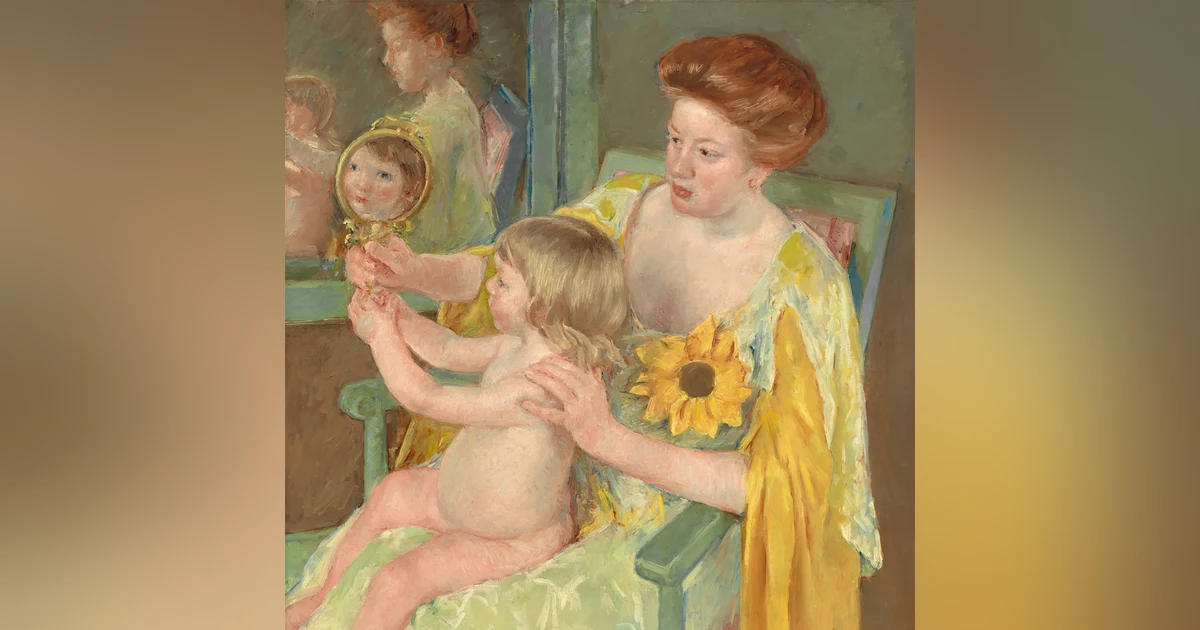
An enormous sunflower is pinned to the gown of a woman seated with a toddler on her lap. They take up most of this large canvas, that’s about 3 ft tall by 2 feet wide.
They’re lit by diffuse warm light coming from the upper left and sit on a grass green wooden armchair in the corner of a room. There is an indistinct pattern of peach, red and light green patches on the padded backrest and seat. You can see it peeking out behind the woman’s left shoulder and curving around the frame under her legs. The walls behind and next to them are a greenish-brown.
The woman, child and chair form a diagonal running from upper right to lower left, where they run off the canvas. The pair sort of face us but are angled away a little to our left.
The woman looks like she might be in her 30s with long, upswept copper red hair, brushed up off her forehead and neck and gathered in the back. Thin reddish eyebrows curve over her brown eyes and her lips are a peachy red. She and the little girl have creamy skin flushed with rose pink. Blue undertones create soft shadows...
She wears a long celadon green gown decorated with clusters of thinly painted white strokes with broad washes of lemon yellow and creme across the skirt. The bodice is covered with patches of pea soup green and golden yellow with streaks and daubs of cream, navy blue and light green mixed in.
That sunflower is pinned just below the deeply scooped neckline, covering most of the left side of her chest, on our right. It’s a beautiful goldenrod yellow with its petals roughly outlined in dark brown.
The best part of this dress is the sleeves. They are magnificent! Her left sleeve, on our right, is made from two pieces layered over each other. The green-yellow pattern carries over to the elbow length outer sleeve which is split at the front of the shoulder. A long inner sleeve, the same goldenrod yellow as the flower, cascades down from under that split, looking like it would hang past her knees if she was standing. It parts at the elbow where her left forearm emerges.
The arm extending from that glorious sleeve reaches toward the little girl in her lap, her hand placed gently on her shoulder. She appears to be around 2 years old. Her pale, round belly rests on rosy, pudgy little legs as she straddle the woman’s knee. Her honey blond hair starts out chin length, and gets longer as it angles back to cover her neck. She’s turned her head and shoulders away from us, reaching up and to our left, to grasp the handle of a brass or bronze hand mirror. The woman also holds the mirror with her right hand, her head slighted titled to see the girl’s reflection.
The mirror is filled with the little girl’s face, very loosely painted. Her bangs sweep across her forehead, framing dark eyes that seem to be uncertain of what she’s seeing.
Another large mirror hangs on the wall next to them, with its lower right corner extending down from the upper left. It’s framed in the same grass green wood as the chair. The little girl appears here too but it’s the women whose reflection takes up the most space. We see her right shoulder and arm, and more of the padded backrest and top of the chair. It’s also painted roughly, without a lot detail, creating a blurred reflection.
It’s a tender scene but neither of them smile. They appear to be thoughtful more than anything. And something seems off. We’re positioned at an angle, looking down at them. But as I kept looking I realized that the arm of the chair closest to the wall next to them looks normal but the arm closest to us tilts downwards. And that sort of unsettled feeling is accentuated by the way the woman also leans towards us, bracing herself on the armrest.
MUSIC
This painting has a great story. Art historian Dr. Nikki Georgopulos has discovered the secret of the sunflower! She wrote about it in a blog post on the Gallery’s site, I’ll include a link in the shownotes.
For a long time, the painting was called “Mother and Child” and most people thought the sunflower was just a decoration. But Nikki was researching it for her dissertation and found out the sunflower was the symbol of the women’s suffrage movement. Cassatt painted this in 1905, when the fight for women’s rights was in full swing.
She says about Cassatt, “A fierce advocate for women’s rights she was unafraid of using her work to advance the cause.” And gold was one of the suffragists’ colors, which could explain that fantastic sleeve!
But instead of listening to me go on about it, let’s hear the story from her!
MUSIC
Karen: Dr. Nikki Georgopoulos is the Andrew w Mellon postdoctoral curatorial fellow in the department of French paintings at the national gallery of art. Nikki, thanks for joining us. And that is one impressive title.
NIkki: Thanks, Karen, it's great to be here with you on your podcast. And yeah, it's a bit of a mouthful to it's a lot to carry around. My business card is very long.
Karen: One thing that stood out for me, reading your post was how you were captivated by the sunflower as you put it, which previous scholars had just dismissed as a decoration. What motivated you to keep looking at it?
NIkki: That's a great question. And the actual answer is that I, I kind of came upon Uh, I hesitate to use the word discovery, but I came upon this secondary meaning of the sunflower in an almost accidental way. It just sort of presented itself to me. It did occur to me that scholars performing, who had discussed the painting had described it as a decoration.
Even though it's so central to the painting, both in terms of its composition and in the paintings original title, which is in French that by multiple news, which means this lumen with the sunflower. And so there was this sort of nagging question to me of why this sunflower was given such prominence by Cassatt both compositionally and in the title.
So I had that question lingering in my mind. As I was working on this painting, I was pursuing a simultaneous path of research into Cassatt's interest in and devotion to the American suffrage movement in the early 20th century and was doing just some basic background information on. Not only the women's suffrage movement, but also its inherence in visual culture.
There've been some great books written about how the women's suffrage movement really mobilized visual culture, which is to say buttons and stick pens and banners, and really used visual material as part of their political campaign. And I came to find that the sunflower was adopted as the official symbol of the national American women's suffrage association in 1896.
And this is about 10 years before Cassatt made this painting. And around the time that she became interested in the American women's suffrage movement, and it sort of all just came together at the moment of constellation.
Karen: Were you hesitant to say, this is what it is given the history of so many people kind of blowing off the sunflower is just a decorator.
NIkki: Sure. I mean, there's always a little bit of, um, hesitation, but I think that what's interesting is that when you're studying someone like Cassatt, who is a 19th century artists, Who has largely been written about as, and described as, and admired for her paintings of as her first biographer, put it mothers and children as if this subject is small, in some ways, if it's not important, it's not political.
It's not modern. It's not, that's not edgy in some way. And I think that that's absolutely untrue for Casa knowing her own political beliefs. And I think that I was so used to coming up against this sort of impoverished idea of croissant as a political painter, as someone who's deeply devoted to modernity and its different visual appearances.
That I was already prepared to sort of suspend my own hesitation. I think there's also a fear on the part of art historians to appear anachronistic. There's a sort of what I call a scholarly allergy to calling Casa a feminist, because there's no written record of her ever using that word to describe herself, even though there is a wealth of evidence.
To support the idea that she was someone who was deeply devoted to the idea of the equality of the sexes and genders, and was devoted to women's equality, both politically and domestically. So I think there's always a bit of fear, especially for someone like myself. Who's a young scholar. When I started in, on this research, it was while I was writing my dissertation is before I completed my PhD.
So it did feel a little like I was, um, sitting at the adults table for the first time.
Karen: That's fantastic though, to just have the convictions of your research. And as a matter of fact, that kind of leads me to another question. As you said, she was really well known as a painter of mothers and children. But your interpretation of the relationship between the two people we see in this painting is pretty different.
Can you tell us about that?
NIkki: Sure. And actually, I'll just say from the beginning that I don't have a sort of speculative opinion about their relationship. I'm not so certain that in this case, as in many others in paintings and prints that Cassatt was making around this time, I don't think she was actually interested in the relationship between two real people. She often painted family members and friends, and that's a very different portion of her career in painting.
It's happening simultaneously, but there's always a real difference. I can at least tell from looking at her work so closely over the years. There's a difference between when she's painting people who are related or who are friends versus when she's just painting models.”
It's been well known for a long time that especially later in her career, She often paired models that were unrelated. So often you see her sort of what I call them, mix and match of young women, young adults, or teenagers and babies. So there's nothing to suggest that this particular woman was related to this particular child.
And in fact, both of these models, the child and the woman appear in other paintings with other
Karen: Oh, really? Okay.
NIkki: Yeah. So I don't think she was necessarily interested in. Quote unquote, real relationship between these two models. More of our, I think she was interested in what I call the intergenerational relationship between women and girls.
This was something that she, as a woman who at this point is in her mid sixties. Uh, she's getting on in here. And so she's thinking about sort of future sure. Generations of younger women, especially she's becoming more and more devoted to suffrage as a movement. She's mentoring younger women in terms of art collecting, in terms of being working artists.
And so I think she really concerned with making a better world for women by women. This is why she was so devoted to getting women to vote in the United States. So there's this wonderful quote that she wrote in a letter in the midst of world war one, when she was actually displaced from her home by German troops.
And she wrote to her friend, she said, if the world is to be saved, it will be women who save it. And I think she's really aware of the fact that it is. Upon women of her generation to ensure a better future, a more equitable future for girls that were up and coming. So this is all a roundabout way to say that I don't know what the relationship between these two figures is.
I think it's more allegorical than personal. She's more interested in what that kind of relationship might represent more broadly speaking.
Karen: So the older woman could be a guide or mentor perhaps to the little girl. Maybe we can talk about the mirrors in a second, but I think that use of mirrors and literal reflection and the kind of thoughtfulness that that action can produce seems to be a big part of it too. I described the scene is looking tender, but they seem more thoughtful than anything else.
NIkki: Absolutely. I think she has this amazing ability to paint women and children in a way that is tender, but not overly sentimental. I think that's something we overlay as viewers. Onto her paintings and her prints as well. There's a way in which she does not have an overly romantic view of what it is to care for children.
Um, they are often fussy. They often look bored. Um, there's something very honest about her portrayal of the interaction between women and children. I hesitate to. Too much attention to her biography, but I do think it's telling that Cassat herself never had children. She was a very active aunt. She had a lot of nieces and nephews, and so she was familiar with modes of relating to children that were not maternal. I don't think she was discounting the importance of maternity or of the maternal caregiving relationship. But I think she understood it as only one among many roles that women can play. I don't think for her womanhood is reduceable to motherhood, which of course in the 19th century, it often was in public discourse in the public imagination.
Karen: The painting was called mother and child for years. So how did you get the gallery to restore the title? That's pretty cool.
NIkki: Well, there's a long story and a short story. The history of titles is always very interesting. That painting has been known by something like 14 different titles. I can tell you that the first time it was exhibited, which was in 1908, right after the first owner of that painting bought it directly from Cassatt.
It was acquired in France, by a French owner exhibited in France. So it was under the French title, which was the media. So actually nothing to do with sunflowers and nothing to do with them, Trinity. However, when it was sold in 1914, it was sold under the title woman with a sunflower and then in parentheses the mirror.
And when it was sold again, it had that same title. If we're thinking about how we decide on what titles hold the most informational value, we're always thinking about in the artist's lifetime when the artists may or may not have had any say in how the painting was titled. The way that I got the gallery to change the title is essentially by reconstructing its history in this way and reconstructing the history of the painting's titling. Essentially, my argument is that the title of mother and child not only assumes a maternal relationship between the two models, which we don't know to be true, but furthermore, obscures the centrality of the sunflower in the paint. And the really funny story about how the ball got rolling about this is that in 2018, when I was doing this research, I was presenting it at a conference here in DC at American university, and was sort of getting to this climax of criticizing the national gallery of art for titling this painting incorrectly.
And it really didn't have that title, mother and child until it entered the national gallery of art. And I actually found that document, in what are called the Chester Dale papers where a curator crossed out women with a sunflower and wrote in mother and child. So I found that document.
Karen: No kidding.
NIkki: And I'm standing at the podium going on and on and I looked down in the front row is Mary Morton, who is the head of French paintings. And now my boss, but I recognized her as I was criticizing her. And I thought, oh, my career is over. Fantastic. Great. I have made an enemy. Luckily, Mary is an incredibly open-minded and forward thinking curator and our historian and great devotee of feminist art history and, um, Mary Cassatt and came up to me afterward and was so excited to hear about my research.
So she was very open-minded about hearing my reasons. As to why I think things title needed to be changed that to women with the sunflowers. That's how that happened. It was very fortuitous. Partly she was in a good mood that day.
Karen: Oh, my God. I can't even imagine I would just die.
NIkki: Yeah, it was hard
Karen: Wow. Well, I'm glad the story has a happy ending. That's excellent. I compliments to Dr. Morton for being so broad minded. You know, you brought up the mirror a few times and it's interesting that that was actually one of the original titles because Did Cassatt not title the work herself?
NIkki: Unclear. Unfortunately, nowhere in her correspondence that has been published. And the issue is that a lot of her correspondence is sort of diffused. So it's hard. It's hard to tell if I've read every single scrap of paper that exists, that she's ever written. She has never referred to the painting by title.
Unfortunately. It's very tricky. And knowing her, she often changed title and she had this sort of like rolling list of titles for many work. So it would sort of shift from there. Um, I cannot say for certain whether she herself titled it, I do know that the first owner who was an art critic named Roger Max who exhibited it in 1908 under the title The Mirror, was a close correspondent, and it was exhibited at the Durand-Ruel Gallery.
That was her main dealer at the time. So we can at least assume that she had been unhappy with the title. She would have been able to step in, but unfortunately it's fairly speculative beyond
Karen: It's just so interesting though, that mirrors became the focus at the very beginning. The one that the woman and child holds together. We've talked about it a little bit of maybe there's that kind of generational leadership or connection. Like here, kid I'm showing you a better future, hopefully, but there's a great big mirror that hangs behind them.
NIkki: I'm so glad you asked, actually, my dissertation, which I'm now working on, turning into a book is about mirrors in painting in the 19th century. And I have an entire chapter on Cassatt because she has dozens of mirrors throughout her paintings, drawings, and prints throughout her entire career. It is a recurring motif that is something that captivates her as a formal device, but also in my estimation, a more symbolic one as well. So this to me is one of her great nearer paintings.
The significance of the mirror from how I understand it for Cassatt is twofold. First of all, In the 19th century, the mirror was this favorite subject for painters and artists who were grappling with the idea of realism and what it meant to label yourself as an artist, as someone who has a relationship to the real, as opposed to the ideal or the historical or the imaginary and cause for Cassatt the category of realism as a sort of art, historical category was incredibly important.
So she was putting herself into dialogue with this tradition in 19th century painting that is often placed at the beginning with Gustave Courbet. So I think that formally there's something there in terms of how she's thinking in terms of a lineage of realist artists and realist painters, which is interesting because we often think of her as an impressionist, but I think that realism for her as a more important and more powerful category of aesthetic organic.
But if we think about how mirrors appear throughout art history, especially back to the 18th century, there were very feminine emblems. Often you see them in paintings of women in their bedrooms, and they're often used to give the viewer any color. Or augmented view of the woman's body, um, sort of catering to the male gaze.
And allegorically symbolically, they're often a symbol of vanity of beauty, of superficial reality in this way. So there's something to be said for how mirrors are often paired with women to their detriment, to suggest that all they are is a surface. All they are is body and Cassatt in my estimation, really reclaims the mirror as a space of feminine creative potential. The other thing that we associate with mirrors, especially in the visual arts is the application of makeup. We see there are tons of images of women applying makeup, and actually in the 19th century, there's an analogy drawn between. A woman applying makeup and a painter painting.
I think she really takes this up as a challenge as a woman and as an artist to rethink how that negative symbol could be. Re-imagined in a positive way. She herself is both a woman and a painter. I think that there's this really, for lack of a better word, a sort of feminist undertow really that ties together her entire career of painting mirrors that really reaches its apex at this moment in 1905, when she finds herself devoted to the feminist movement in the United States, even though she's living in France at the time.
Karen: All right. That's great. I think that is a great place to wrap up. Nikki. Thank you so much for being on today. This has been a fantastic discussion and really some amazing insights into a work that a lot of people know and love, but probably had no idea of the history of, so this was great. Thank you.
NIkki: Thank you. It's been a pleasure.
Once again you can find Nikki’s post, Mary Cassatt’s Suffragist Symbolism at nga.gov.
I love Nikki’s story because it just shows that there’s always something new to learn. So for any budding art historians out there, never assume that what we think we know about a work of art is written in stone!
If you’d like to follow Nikki, she’s on LinkedIn and Instagram @nikki.longname.
OUTRO:
You can find links to today’s information in the show notes at alonglookpodcast.com and in most podcast apps. While you’re there, you can leave a comment or ask a question. I’d love to hear from you!
If you don’t want to miss an episode, you can find player links on the site or just hit subscribe or follow wherever you listen to podcasts!
Thanks again to Dr. Georgopulos and as always, thanks for joining me!