Autumn Drama by Alma Thomas


 Podcast Addict
 Overcast
Click here to view "Autumn Drama" on the Gallery's site. Clicking the image on their page will open a viewer that allows you to zoom in and pan around.
Talk about a second act! Alma Thomas was a longtime art teacher in Washington DC, who began her art career after 35 years of teaching. She took inspiration from nature, color theory, and the works of artists she met through her involvement in the DC arts scene. All of this developed into her unique, colorful style.
We'll find out how she found success at age when most people have long since retired and achieved national recognition most artists dream of. And what she had in common with Henri Matisse!
SHOW NOTES
"A Long Look" theme is "Ascension" by Ron Gelinas youtu.be/jGEdNSNkZoo
Episode theme is "All About the Sun" by Quantum Jazz.
Autumn Drama
https://www.nga.gov/collection/art-object-page.195514.html
Alma Thomas information
https://www.nga.gov/features/african-american-artists.html
https://americanart.si.edu/artist/alma-thomas-4778
https://en.wikipedia.org/wiki/Alma_Thomas
Alma W. Thomas : A Retrospective of the Paintings, Fort Wayne Museum of Art, 1998
(online book, best viewed in browser)
Whitney Museum of American Art exhibition catalog
The Art of Color: The Subjective Experience and Objective Rationale of Color, Johannes Itten
Alma Thomas. Autobiographical writing by Alma Thomas on her Earth paintings, before 1978. Alma Thomas papers, circa 1894-2001. Archives of American Art, Smithsonian Institution.
National Arboretum in October photographed by DC Gardens, courtesy of the National Arboretum CC BY
The post Autumn Drama by Alma Thomas appeared first on A Long Look.
Americans on average, spend about six to 10 seconds looking at works of art in museums.The slow art movement encourages people to slow down and spend more time with a work of art.
Now, this kind of looking can create more questions than answers. And that's where the fun starts—digging up information about the work and the artist. Later on in the show I’ll tell you what I find out!
So join me while I take a long look at works in the gallery’s collection.
MUSIC
Today I’m looking at Autumn Drama by Alma Thomas
If you want to follow along, you can find it on the gallery’s website, www.nga.gov.
So what do you first notice?
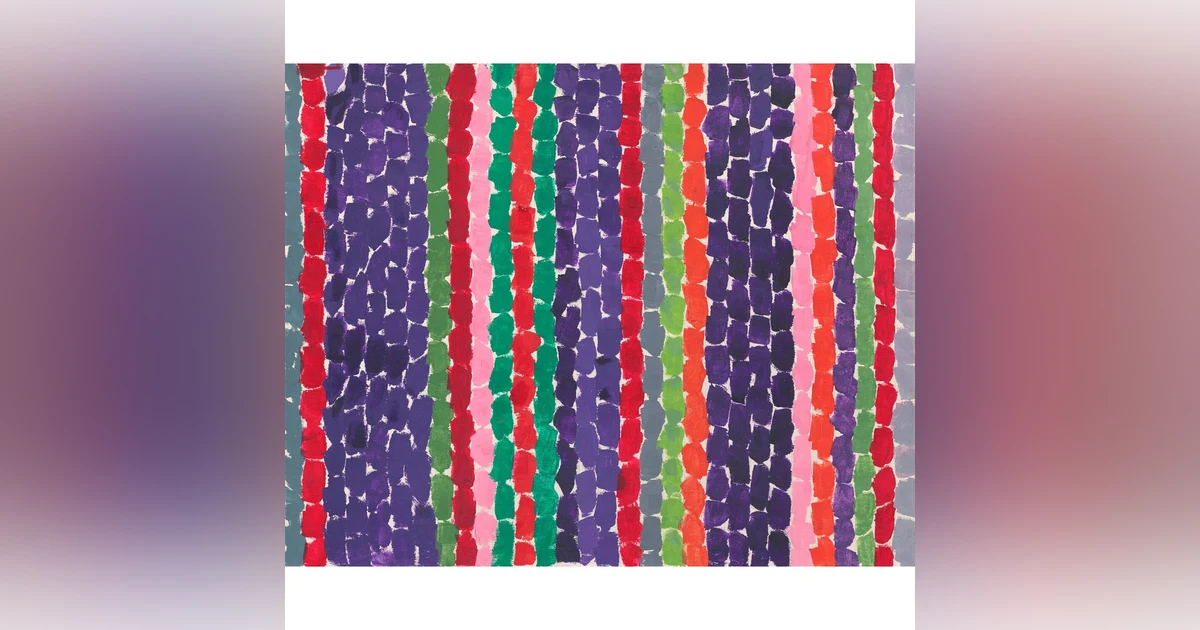
Thick broken lines of color parade across and off the edges of this canvas, which is about 2 feet high by 3 feet wide. The vertical lines are built with short, blocky strokes of color. Bits of white canvas peek out from the gaps between them. The strokes form irregular rectangles about 2 inches wide. Thomas used acrylic paints so the colors are rich and vibrant.
It’s very playful but there’s an order to it. Groups of purple lines are interspersed among single lines of color. So here’s the progression, ready? Going from left to right: steel blue, cherry red, 5 purple lines; grass green, red, pink, turquoise, red, turquoise, 3 purple lines, red, steel blue, lime green, orange, 4 purple lines, pink, orange, 1 purple line, lime green, red, and finally lavender.
The ways these irregular shapes all interconnect reminds me of a mosaic.
So how is such a cheerful painting called Autumn Drama?
MUSIC
Alma Thomas was a Black artist in Washington DC who found success late in life. She was born in Columbus, Georgia in 1891, the oldest of four girls. At 15, her dad moved the family to Washington DC because there was no high school in Columbus that would accept black students. She eventually attended Howard University in DC and was the first graduate of its new art department. She became an art teacher, spending her whole 35 year career at Shaw Junior High School in the city. While teaching, she also earned her masters degree in arts education from Columbia University.
She kept up her own art education by taking painting classes at American University during the ’50s, where she began experimenting with abstract and expressionist art. She had been working in a more realistic style up til then.
Thomas was really active in the DC arts scene. She organized the School Arts League where junior high school students learned about art through trips to the city’s museums and lectures on Black artists. She launched an art gallery at Shaw Junior High featuring works by Black artists lent by Howard University. In the ’40s she became vice president of the Barnett Aden Gallery, the first gallery to break the color barrier in DC.
When she finally retired in the ’60s, she had such a bad attack of arthritis, she almost gave up painting. But when she was offered a show at Howard University, she became determined to keep working. There’s a great exhibition catalog called Alma W. Thomas : a retrospective of the paintings that tells the story.
She spent a year in bed, recuperating and watching the light flicker through the leaves of the holly tree out her front window. She began to realize the patterns the leaves made could be incorporated into her own art. She also took inspiration from Henri Matisse, who made compositions out of cut pieces of color paper when he became too old and ill to paint. She basically had the attitude, “if he can do it, so can I.”
Color and pattern became her passion, inspired by that flickering light on the trees and garden outside her windows and led her to, as she said, “paint something different from anything I’d ever done.”
Another favorite inspiration were the flower beds in the city’s National Arboretum. It’s a gorgeous place, well worth a visit, and as of this recording in August 2020, is still open!
Autumn Drama is one of a series she called Earth paintings. I found a manuscript she wrote where she talks about them. She says, “Autumn, with the aid of Jack Frost, gives overwhelming, luscious, strong colors to the earth to enrich man’s soul, seemingly relieving him of the hardships he encounters in life.”
“My earth paintings are inspired by the display of azaleas at the Arboretum, the cherry blossoms, circular flower beds, the nurseries as seen from planes that are airborne, and by the foliage of trees in the Fall.”
I found a stunning photo of the Arboretum in October which I’ve included in the blog post. You can definitely how its dramatic colors would have been a big inspiration!
While nature was hugely important, she also studied and experimented with color theory. Thomas explained the importance of color saying, “Man’s inspiration comes from nature. A world without color would seem dead. Color is life. LIfe is the mother of color. Light reveals to us the spirit and living soul of the world through colors.”
She wasn’t the only DC artist fascinated by color. Two artists pushing abstract art in a new direction were Gene Davis and Kenneth Nolan. Through their focus on color and geometry, they became big influences on her work.
Through her work at the Barnett-Aden Gallery she got to talk with artists from all over the country, which helped her keep up with emerging directions in art. She drew inspiration from books, art magazines, visits to New York galleries, even a trip to Europe sponsored by the Tyler School of Fine Art at Temple University.
But by 1969 when she painted Autumn Drama, she had come up with her own unique style.
Her work was popular right from the start. She worked out her abstract composition ideas in watercolors. which were then shown at the Dupont Theatre Art Gallery in the early 60s and they almost always sold out.
Thomas really hit her stride in her 70s, when she developed these mosaic-like patterns. Sometimes they were used in fields of lines like this one. In others they formed concentric circles that expanded outward til they ran off the canvas.
As a child in Georgia, Thomas wasn’t even allowed into museums. But at 81 years old, she was honored with a solo exhibition at the Whitney Museum of American Art, the first Black woman artist to do so. Later that year she was given another solo show at the Corcoran Gallery in DC. Her work was added to the Metropolitan Museum’s permanent collection and has been displayed in the White House and US embassies around the world.
If you’d like to see more of her work, the Smithsonian American Art Museum has a great collection. I’ll include a link in the show notes.
Thomas died in 1978 at 86 years old, leaving behind a large body of work that can be found in museums around the country and a national reputation that continues to grow.
OUTRO:
So this is what slow art is all about. Let the art kind of reveal itself. The Slow Art website recommends 5 to 10 minutes. I hope you’ll try this out when you can finally visit a museum and you can find more info at www.slowartday.com
You can find links to today’s information in the show notes at alonglook-slowart.com and in most podcast apps. While you’re there, why not subscribe and share? It’s free and that way you and your friends won’t miss an episode! You can find subscription links and social buttons near the end of each post.
Thanks for joining me!