Adam and Eve


 Podcast Addict
 Overcast
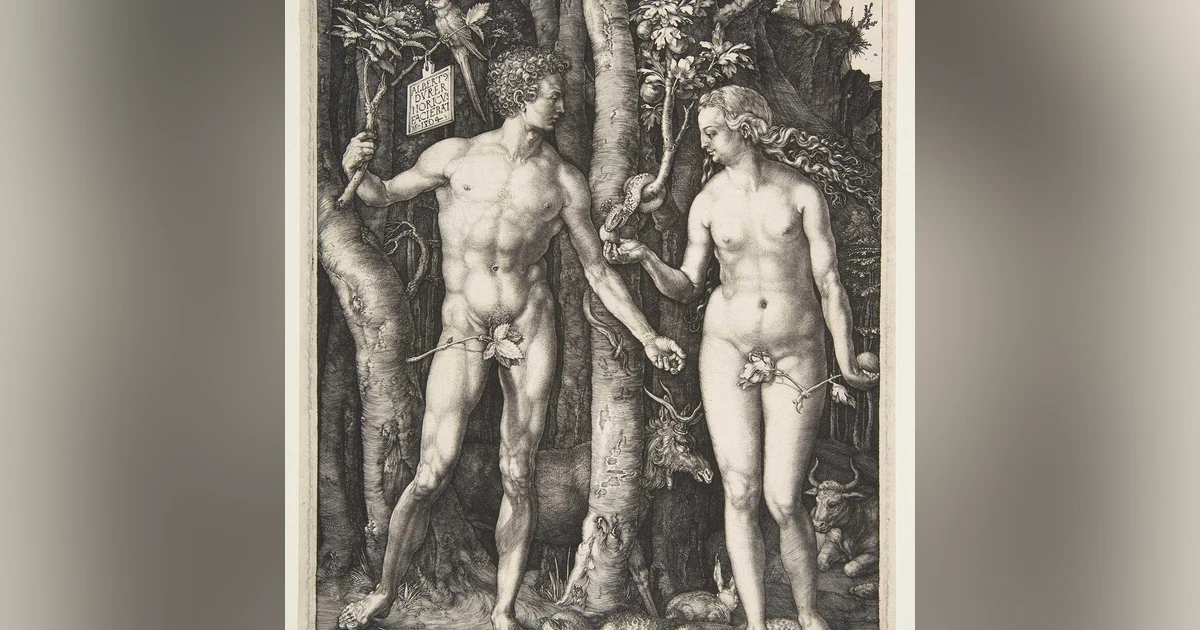
In today's A Long Look, we'll find out how German artist Albrecht Dürer pushed the limits of engraving by experimenting with tools used by armorers and goldsmiths. And we'll discover how his love of Italian art and fascination with the human body led to this work.
Plus, we'll find out the meaning of that menagerie of animals surrounding these two. You won't believe who the parrot might represent!
SHOW NOTES
"A Long Look" theme is "Ascension" by Ron Gelinas https://youtu.be/jGEdNSNkZoo
Episode theme is "Dowland Lachrimae, or Seven Tears - 5. Lachrimae coactae" composed by John Dowland. Performed by I Solipsisti, courtesy of musopen.org.
Artwork information https://www.metmuseum.org/art/collection/search/336222
Albrecht Dürer information https://www.britannica.com/biography/Albrecht-Dürer-German-artist#ref1949
Gothic and Renaissance Art in Nuremberg, 1300–1550 (PDF)
One interpretation of the animals (Khan Academy)
Printmaking information
How to Identify Prints / Edition 2 by Bamber Gascoigne
Engraving video (Metropolitan Museum)
Armor images and information
https://www.metmuseum.org/art/collection/search/23944
Did you know most people spend only a few seconds looking at works of art? But what happens if you slow down and take a long look? This season, we’ll be doing this virtually, at museums with great online resources.
So join me today for a long look in the Metropolitan Museum of Art in NYC!
MUSIC
Today I’m looking at Adam and Eve by Albrecht Dürer
If you want to follow along, you can find it at alonglookpodcast.com/adam
So what do you first notice?
A naked man and woman stand facing us, their heads turned to look at each other in this letter-sized image printed with black ink. She’s on our right, he’s on our left. Behind them is a dense, dark, kinda spooky looking forest with trees rising off the top of the page.
They’re lit from the upper left, their muscular bodies delineating with soft shadows, some lighter, some darker. Both have straight noses Roman noses, high foreheads and curly hair. Eve’s streams out behind her like she’s in a strong wind while Adam’s is short, curling around his ear.
They stand on either side of a tree in the middle of the scene and here’s where things get weird. A patterned snake coils around a branch next to Eve that’s about shoulder height and has leaves and fruit hanging from it. What’s really bizarre is he has 4 nails sticking out of his head!
The snake lowers his head to offer Eve the forbidden fruit. She receives it delicately in the fingertips of her left hand just next to Adam’s outstretched right arm. The intersection of her left arm, bent at the elbow, Adam’s outstretched arm and the dangling snake head form a V. Her right arm hangs straight by her side but that hand is curled backwards cupping...something, it’s really hard to make out, even when I zoom in.
Whatever it is, it seems to be the source of a slender branch extending from her right hand that ends in a very conveniently placed leaf covering her genitals. Likewise with Adam. He’s also covered by the leaves of a branch reaching around his hip from a tree on his left.
All the other trees stand straight except for this one. Its trunk is thicker and more gnarled bending away from him before running off the left and top edges. His left hand grasps another branch that’s higher up, near his shoulder. It extends over his head and there’s a parrot sitting on it, looking off the left side. Below it hangs a plaque that says Albrecht Dürer noricus faciebat 1504, which means Albrecht Dürer of Nuremberg made this in 1504.
The central tree and Adam’s tree are lighter than those behind them. Dürer does an incredible job suggesting their rough bark. He uses thin horizontal and curved strokes to create the trunks and branches. Then he creates vertical seams in the bark by surrounding light highlights with darker, denser strokes.
They’re surrounded by animals, some on the ground, other behind them. A sleepy cat lies at the foot of that center tree, facing left with its tail curling around Eve’s feet. It seems to be ignoring the mouse scurrying towards it from Adam’s left foot. Behind the cat, a rabbit with its back to us, stares into the dark forest. To its left, strides an shadowy elk, moving left to right behind Adam’s knees and the trees in the foreground. Behind and to the right of Eve lies an ox, looking completely bored.
Finally, way in the distance is a tiny goat silhouetted against the sky. He’s balanced on the highest point of rocky hills rising over Eve’s right shoulder, filling the upper right corner.
The amount of fine detail in this scene is astounding! Dürer using a combination of short angled lines, spikey lines, curved lines, even dots to build these convincing shadows and textures. Take that cat for example. Its curved back is created with spiky lines and a sort of starburst of short lines radiates out along his haunches. Dense bands of parallel lines create the dark folds of its body while clusters of dots surrounded by lots of white space suggest lighter areas.
So how do you take a bunch of b/w lines and marks and turn them into shadows, muscles, tree bark and fur?
And what’s the deal with the parrot?
MUSIC
Albrecht Dürer was a German artist who lived and worked in Nuremberg from the late 1400s to the early 1500s. This Renaissance man was a painter, illustrator and writer but he’s most famous as a printmaker. He started off working for his dad who was a goldsmith and in the workshop of a local artist creating woodblock illustrations used in books.
Adam and Eve is an engraving which is another printmaking technique. The artist draws an image onto a copperplate and then he or a specialized craftsman called a cutter, carves out the image leaving grooves. Ink is rolled onto the plate, sinking into those grooved lines and the remaining ink is wiped off. Next the plate’s covered with a sheet of paper and they get smooshed together on the press, transferring the inked image onto the paper. I've included a link in the show notes to a really good video demonstration. What you end up with is a black and white image, like this.
Engraving had been around for centuries. It originally was used in metalwork, especially in decorating armor and luxury items like jewelry, cups, plates, and ceremonial or religious items. Dürer would’ve learned this in his dad’s shop.
But like every new medium, he and other artists kept experimenting. They tried out tools used by goldsmiths and armourers, to get different textures and effects. (Armourers are the guys who made armor.) They figured out how to control how the weight of lines and how they could be packed together to create tone. That’s the light and dark shading that suggest shapes--a knee bending under a tunic, for example or the dark scary shadows of a forest. Dürer’s other innovation was using engraving to create really dramatic scenes that often had a religious theme.
Italian art became a big influence on him, especially after a trip he made to Venice in 1494. He saw prints and drawings of classical statues which got him interested in how the human body had been depicted over the centuries. Adam and Eve was created in 1504 and you can totally see that influence in their muscular bodies.
Now about those animals...
At the time, people believed that our health was based on a balance of body fluids and if that balance got out of whack, it affected your emotions and personality. So, the elk represents melancholy which meant your liver was making too much black bile. The cat is choleric, which is anger, crankiness and impatience, caused by too much yellow bile. The ox is phlegmatic, which means there’s too much phlegm in the lungs which makes a person apathetic and sluggish.
And the rabbit is sanguine, meaning have too much blood! This makes a person an optimist but one who likes to overindulge!
But there’s some confusion about what the parrot, mouse and goat represent...
The museum’s catalog explains the parrot represents cleverness as a counterpoint to the sneaky snake. The cat and mouse might suggest the growing tension between Adam and Eve as she takes the forbidden fruit from the serpent.
But I also found sources who said the mouse represents Satan and even that the parrot represents the Virgin Mary and her role in undoing what Eve had done! And the goat is either a reference to the scapegoat in the Bible or a symbol of lust!
And for the snake’s head with nails sticking out of it, one theory says it’s similar to a snake that’s part of the coat of arms of the Münzer family.
OUTRO:
So, I hope you’ll try a long look on your next museum visit! You can find links to today’s information in the show notes at alonglookpodcast.com and in most podcast apps. While you’re there, you can leave a comment or ask a question. I’d love to hear from you.
You can find links to follow A Long Look on the website or your favorite podcast app or streaming service.
Thanks for joining me!